Medieval and Manuscripts
Agriculture in Scotland in the Middle Ages
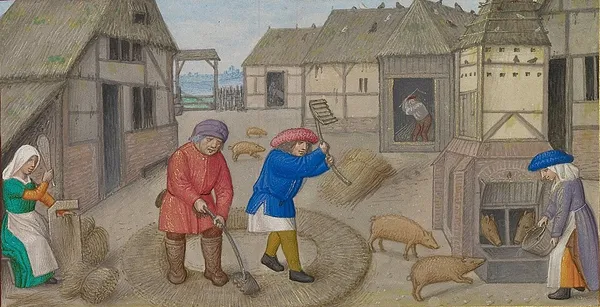
Agriculture in Scotland in the Middle Ages includes all forms of farm production in the modern boundaries of Scotland, between the departure of the Romans from Britain in the fifth century and the establishment of the Renaissance in the early sixteenth century. Scotland has between a fifth and a sixth of the amount of the arable or good pastoral land of England and Wales, mostly located in the south and east. Heavy rainfall encouraged the spread of acidic blanket peat bog, which with wind and salt spray, made most of the western islands treeless. The existence of hills, mountains, quicksands and marshes made internal communication and agriculture difficult. Most farms had to produce a self-sufficient diet of meat, dairy products and cereals, supplemented by hunter-gathering. The early Middle Ages were a period of climate deterioration resulting in more land becoming unproductive. Farming was based around a single homestead or a small cluster of three or four homes, each probably containing a nuclear family and cattle were the most important domesticated animal. In the period 1150 to 1300, warm dry summers and less severe winters allowed cultivation at much greater heights and made land more productive. Arable farming grew significantly, but was still more common in low-lying areas than in high-lying areas such as the Highlands, Galloway and the Southern Uplands. The system of infield and outfield agriculture, a variation of open-field farming widely used across Europe, may have been introduced with feudalism from the twelfth century. Crops were bere (a form of barley), oats and sometimes wheat, rye and legumes. Hunting reserves were adopted by Anglo-Norman lords and then by Gaelic ones. The more extensive outfield was used for oats. New monastic orders such as the Cistercians became major landholders and sheep farmers, particularly in the Borders where they were organised in granges. By the late Medieval period, most farming was based on the Lowland fermtoun or Highland baile, settlements of a handful of families that jointly farmed an area notionally suitable for two or three plough teams, allocated in run rigs to tenant farmers, known as husbandmen. Runrigs usually ran downhill so that they included both wet and dry land.
Also on this shelf
Cathedral of Our Lady of Walsingham (Houston).
Armenian historiography of the 5th–18th centuries.
See also
Uncatalogued shelfText from Wikipedia; plate via Wikimedia Commons. Text CC BY-SA 4.0; plate freely licensed (see Commons). Source record. Images and catalogue data are reproduced from open-access collections.