Medieval and Manuscripts
Byzantine Empire under the Heraclian dynasty
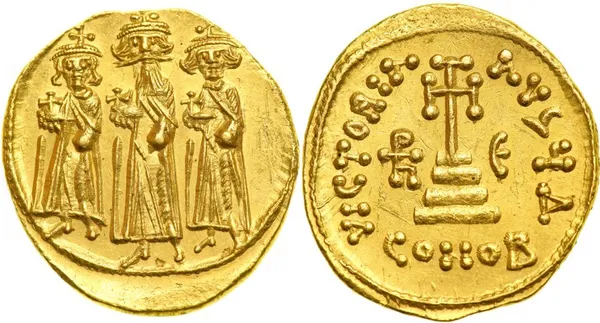
The Byzantine Empire was ruled by emperors of the Heraclian dynasty from 610 to 711 AD. The Heraclian period encompassed the Byzantine–Sasanian War of 602–628, the Early Muslim conquests, and major political, military, religious, and administrative changes that transformed the Roman Empire in the eastern Mediterranean. The reign of Heraclius began during a period of severe crisis, when the Empire was at war with the Sasanian Empire and faced political instability and military pressure on several fronts. Heraclius is generally considered to have probably been of Armenian descent, although the origins of his family remain debated and some sources associate his family with Cappadocia. At the beginning of the dynasty, the Empire retained much of the political, institutional, and cultural heritage of the Roman state of Late Antiquity. During the seventh century, however, prolonged warfare, territorial losses, economic disruption, demographic changes, and internal religious controversies contributed to a profound transformation of the Empire. By the end of the Heraclian period, the Empire had lost most of its territories outside Asia Minor, the Balkans, and a number of remaining possessions in the Mediterranean. Its political and military institutions had adapted to the conditions of the seventh century, while Greek had increasingly replaced Latin as the dominant language of administration and public life. The Empire was increasingly characterized by a more compact territorial core and a society shaped by prolonged warfare with the Caliphate. These developments contributed to the emergence of the medieval Byzantine state, although its rulers and inhabitants continued to identify themselves as Romans. The period ended with the second deposition of Justinian II in 711 and was followed by the period of political instability known as the Twenty Years' Anarchy. The Heraclian dynasty was named after the emperor Heraclius, who, together with his father Heraclius the Elder, the Exarch of Africa, led a revolt against the emperor Phocas in 608. In 610, Heraclius sailed from Carthage to Constantinople, overthrew Phocas, and became emperor. At the time of his accession, the Empire was engaged in the Byzantine–Sasanian War of 602–628. The Sasanian armies subsequently captured large parts of the Empire's eastern territories, as well as Egypt and parts of Anatolia.
Also on this shelf
Erfurt Cathedral.
Christendom.
See also
Uncatalogued shelfText from Wikipedia; plate via Wikimedia Commons. Text CC BY-SA 4.0; plate freely licensed (see Commons). Source record. Images and catalogue data are reproduced from open-access collections.