Medieval and Manuscripts
Byzantium in the Crusading movement
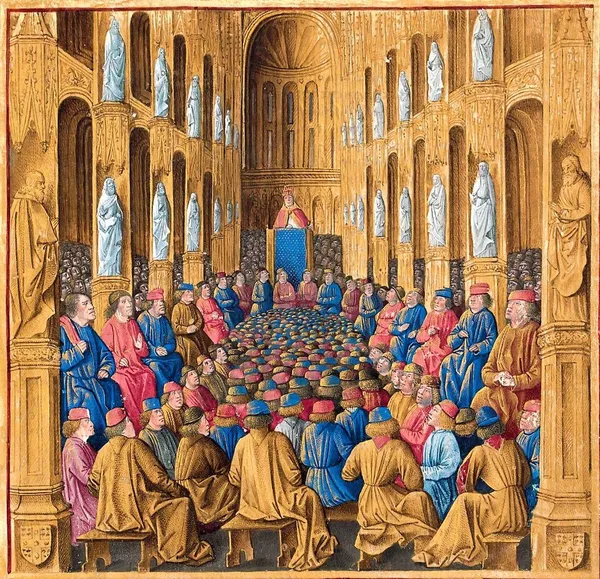
The Byzantine Empire participated in the crusading movement from its inception in the late 11th century, serving as initiator, ally, or adversary. The Byzantines regarded their state as the continuation of the Roman Empire and the centre of the civilised world, although it had lost substantial territories during the early Muslim conquests. The empire recovered some territory after c. 960, but from the mid-11th century faced sustained pressure from several directions, including nomadic Turkomans in Anatolia. Despite strained relations with Western Christendom after the East–West Schism (1054), the Byzantine emperor Alexios I Komnenos sought Western aid, prompting Pope Urban II to proclaim the First Crusade in 1095. Cooperation proved difficult: although the crusaders helped recover parts of Anatolia, they founded four states on former Byzantine lands and often blamed the "schismatic" Byzantines for later failures. Byzantine influence in the Crusader states nevertheless grew as Muslim power in Syria expanded under the Zengids and later Saladin; Manuel I Komnenos extended Byzantine suzerainty over the Principality of Antioch and the Kingdom of Jerusalem and supported joint campaigns against Egypt. Byzantine actions against Westerners and negotiations with Saladin increased Western resentment. Although plans for a crusader attack on Constantinople had long existed, the city did not fall until the Fourth Crusade, largely due to internal Byzantine conflicts. The Sack of Constantinople and the establishment of the Latin Empire on former Byzantine territory in 1204 deepened the rift between Western and Eastern Christians. Byzantine successor states, particularly Nicaea, led the resistance to Latin rule and restored the empire under Michael VIII Palaiologos in 1261. Later Western plans to reconquer Constantinople, though supported by the papacy, had failed by 1320. Late Byzantine rulers sought Western aid against Ottoman expansion through alliances, papal negotiations, and church union, but civil wars, anti-Latin sentiment, and Ottoman military successes repeatedly frustrated crusading plans. Western expeditions brought only limited relief before the Fall of Constantinople in 1453.
Also on this shelf
Christianity in the 1st century.
Byzantine Empire under the Theodosian dynasty.
See also
Uncatalogued shelfText from Wikipedia; plate via Wikimedia Commons. Text CC BY-SA 4.0; plate freely licensed (see Commons). Source record. Images and catalogue data are reproduced from open-access collections.