Medieval and Manuscripts
Dol Cathedral
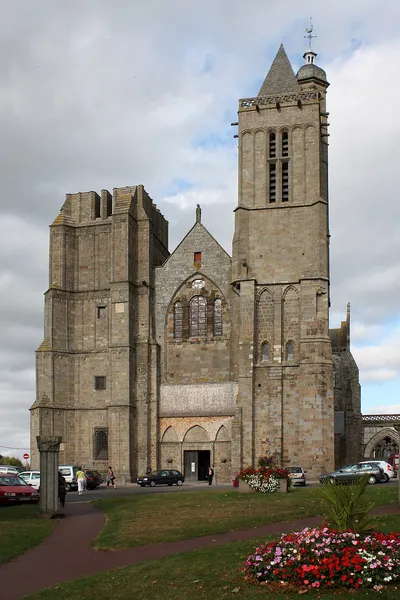
Dol-de-Bretagne Cathedral (French: Cathédrale Saint-Samson de Dol) is a Roman Catholic church located in Dol-de-Bretagne. The cathedral is dedicated to Saint Samson, one of the seven founding saints of Brittany. It was formerly the seat of the Archbishop of Dol, one of the nine ancient bishoprics of Brittany. The cathedral suffered badly from the excesses of the French Revolution, becoming successively a "Temple de la Raison", then a stable, then a warehouse. Revolutionaries caused considerable damage and many treasures were lost. When it eventually returned to being a house of worship, its role as a bishopric was abolished by the Concordat of 1801 when the Dol diocese was merged into the Dioceses of Rennes and Saint-Malo. The Concordat of 1801 was an agreement between Napoleon and Pope Pius VII, signed on 15 July 1801 in Paris, which sought national reconciliation between revolutionaries and Catholics. The Concordat was abrogated by the law of 1905 on the separation of church and state. The building is notable for its eclectic mix of styles and idiosyncrasies, such as the incomplete north tower on the main west-facing entrance. The tower was begun in 1520 but never finished due to lack of funds. A local myth has it that the top was knocked off by the devil, who threw the nearby Dol-de-Bretagne menhir at the building. The current cathedral dates to the 13th century and is primarily Gothic in style with both Norman and English influences. It was built on the site of an old church where Nominoë was crowned as the first king of Brittany in 850. This old church was replaced by a Romanesque style cathedral which was in turn destroyed in 1203 by the soldiers of King John and little is left of that building today. The cathedral has retained little of the old furnishings as in 1742 the cathedral chapter decided to get rid of all the old bishop's tombs and relaid the choir paving and in 1793 the rood screen which had separated the choir from the nave was demolished and was replaced by an iron grill on the orders of the zealots of the revolution. Samson was born in Wales at the end of the 5th century. He became a monk and was the superior of a monastery in Caldey. He moved to Ireland and in around 548 made the journey to Armorica with several colleagues and founded a monastery there.
Also on this shelf
Bible.
National Register of Historic Places listings in Albany, New York.
See also
Uncatalogued shelfText from Wikipedia; plate via Wikimedia Commons. Text CC BY-SA 4.0; plate freely licensed (see Commons). Source record. Images and catalogue data are reproduced from open-access collections.