Maritime History
Battle of the Atlantic
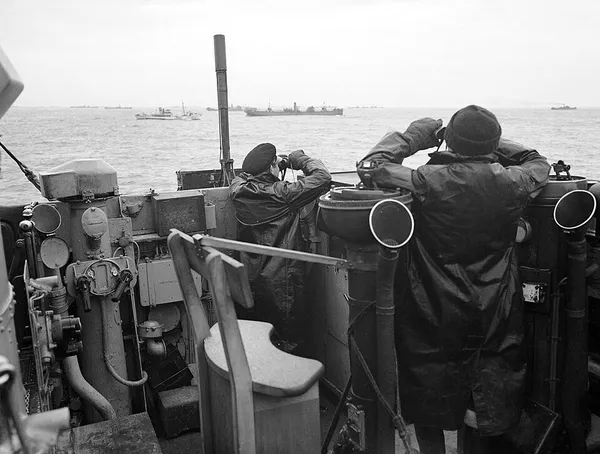
The Battle of the Atlantic, the longest continuous military campaign in World War II, ran from 1939 to the defeat of Nazi Germany in 1945, covering a major part of the naval history of World War II. At its core was the Allied naval blockade of Germany, announced the day after the declaration of war, and Germany's subsequent counterblockade. The campaign peaked from mid-1940 to the end of 1943. The Battle of the Atlantic pitted U-boats and other warships of the German Kriegsmarine (navy) and aircraft of the Luftwaffe (air force) against the Royal Navy, Royal Canadian Navy, United States Navy, and Allied merchant shipping. Convoys, coming mainly from North America and predominantly going to the United Kingdom and the Soviet Union, were protected for the most part by the British and Canadian navies and air forces. These forces were aided by ships and aircraft of the United States beginning on 13 September 1941. The Germans were joined by submarines of the Italian Regia Marina (royal navy) after Germany's Axis ally Italy entered the war on 10 June 1940. As an island country, the United Kingdom was highly dependent on imported goods. Britain required more than a million tons of imported material per week in order to survive and fight. The Battle of the Atlantic involved a tonnage war: the Allies struggled to supply Britain while the Axis targeted merchant shipping critical to the British war effort. Rationing in the United Kingdom was also used with the aim of reducing demand, by reducing wastage and increasing domestic production and equality of distribution. From 1942 onwards, the Axis also sought to prevent the build-up of Allied supplies and equipment in the UK in preparation for the invasion of occupied Europe. The defeat of the U-boat threat was a prerequisite for pushing back the Axis in western Europe. The outcome of the battle was a strategic victory for the Allies—the German tonnage war failed—but at great cost: 3,500 merchant ships and 175 warships were sunk in the Atlantic for the loss of 783 U-boats and 47 German surface warships, including 4 battleships (Bismarck, Scharnhorst, Gneisenau, and Tirpitz), 9 cruisers, 7 raiders, and 27 destroyers.
Also on this shelf
Confiance (1797 ship).
1942.
See also
Uncatalogued shelfText from Wikipedia; plate via Wikimedia Commons. Text CC BY-SA 4.0; plate freely licensed (see Commons). Source record. Images and catalogue data are reproduced from open-access collections.