Maritime History
Genesis flood narrative
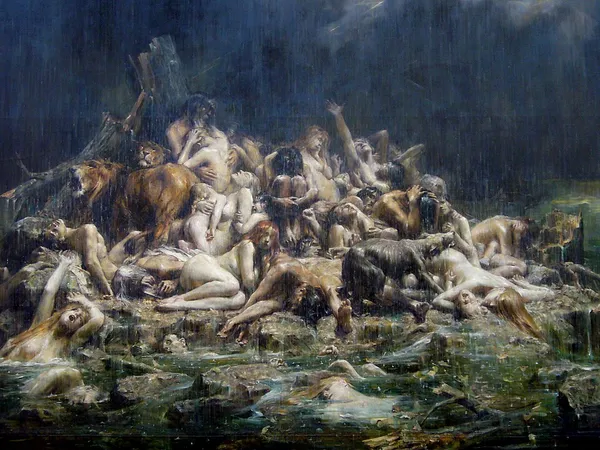
The Genesis flood narrative (chapters 6–9 of the Book of Genesis) is a Hebrew flood myth. It tells of God's decision to destroy creation, saving only Noah and the people and animals who went with him into an ark built on God's instructions. Scholars generally believe it was adapted from older Mesopotamian flood traditions, especially the Epic of Gilgamesh, which originated in the early 2nd millennium BCE and later spread to the Levant. The Book of Genesis was probably composed around the 5th century BCE; some scholars believe that primeval history (chapters 1–11), including the flood narrative, may have been composed and added as late as the 3rd century BCE. It draws on two sources, called the Priestly source and the non-Priestly or Yahwist, and many of its details are contradictory. A global flood as described in this myth is inconsistent with the physical findings of geology, archeology, paleontology, and the global distribution of species. A branch of creationism known as flood geology is a pseudoscientific attempt to argue that such a global flood actually occurred. Some Christians have preferred to interpret the narrative as describing a local flood instead of a global event, particularly in regards to the Black Sea and Persian Gulf, both of which were considerably lower in prehistoric times. Still others prefer to interpret the narrative as allegorical rather than historical.
Also on this shelf
Donald's Quay.
HMS Active (1799).
See also
Uncatalogued shelfText from Wikipedia; plate via Wikimedia Commons. Text CC BY-SA 4.0; plate freely licensed (see Commons). Source record. Images and catalogue data are reproduced from open-access collections.