Maritime History
Cutty Sark
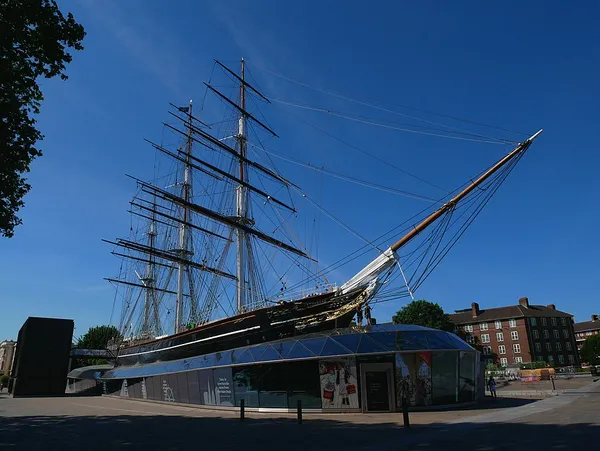
Cutty Sark is a British clipper ship. Built on the River Leven, Dumbarton, Scotland in 1869 for the Jock Willis Shipping Line, she was one of the last tea clippers to be built and one of the fastest, at the end of a long period of design development for this type of vessel, which ended as steamships took over their routes. She was named after the fictional witch who wore only a short shift (a "cutty sark" in the Scots language) in Robert Burns's poem Tam o' Shanter, first published in 1791. The witch Cutty Sark ran after Tam o' Shanter, who was fleeing on his horse, and caught the horse's tail at the Brig o' Doon. The name was an association between the speed of the fictional witch and that of the clipper ship. After the big improvement in the fuel efficiency of steamships in 1866, the opening of the Suez Canal in 1869 gave them a shorter route to China, so Cutty Sark spent only a few years on the tea trade before turning to the trade in wool from Australia. Continuing improvements in steam technology early in the 1880s meant that steamships also came to dominate the longer sailing route to Australia, and the ship was sold to the Portuguese company Ferreira and Co. in 1895. She was renamed Ferreira. She continued as a cargo ship until purchased in 1922 by retired sea captain Wilfred Dowman, who used her as a training ship operating from Falmouth, Cornwall. After his death, Cutty Sark was transferred to the Thames Nautical Training College, Greenhithe, in 1938 where she became an auxiliary cadet training ship alongside HMS Worcester. By 1954, she had ceased to be useful as a cadet ship and was transferred to permanent dry dock at Greenwich, London, for public display. Cutty Sark is listed by National Historic Ships as part of the National Historic Fleet (the nautical equivalent of a Grade I listed building). She is one of only three remaining intact composite construction (wooden hull on an iron frame) ships from the nineteenth century, the others being the clipper City of Adelaide, now in Port Adelaide, South Australia, and the warship HMS Gannet in Chatham. The beached skeleton of Ambassador, of 1869 lying near Punta Arenas, Chile, is the only other significant remnant of this construction method. The ship has been damaged by fire twice in recent years, first on 21 May 2007 while undergoing conservation.
Also on this shelf
Dare House.
Grand Bank.
See also
Uncatalogued shelfText from Wikipedia; plate via Wikimedia Commons. Text CC BY-SA 4.0; plate freely licensed (see Commons). Source record. Images and catalogue data are reproduced from open-access collections.