Maritime History
Battle of Tsushima
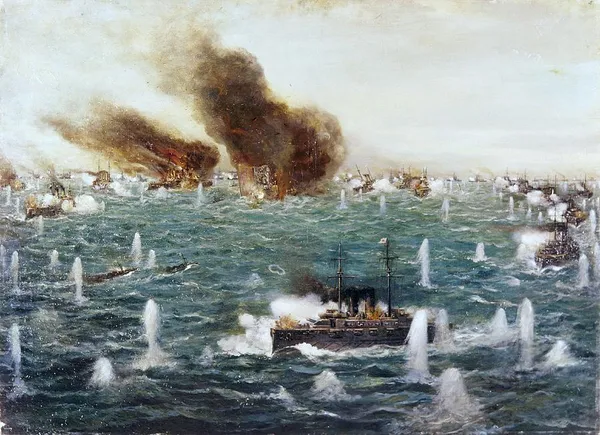
The Battle of Tsushima was the final naval battle of the Russo-Japanese War, fought on 27–28 May 1905 in the Tsushima Strait. A devastating defeat for the Imperial Russian Navy, the battle was the only decisive engagement ever fought between modern steel battleship fleets and the first in which wireless telegraphy (radio) played a critically important role. The battle was described by contemporary Sir George Clarke as by far the greatest and the most important naval event since Trafalgar. The battle is known in Japan as the Naval Battle of the Sea of Japan. The battle involved the Japanese Combined Fleet under Admiral Tōgō Heihachirō and the Russian Second Pacific Squadron under Admiral Zinovy Rozhestvensky, which had sailed over seven months and 18,000 nautical miles (33,000 km) from the Baltic Sea. The Russians hoped to reach Vladivostok and establish naval control of the Far East to relieve the Imperial Russian Army in Manchuria. The Russian fleet had a large advantage in the number of battleships, but was overall older and slower than the Japanese fleet, and was outnumbered nearly three to one in total hulls. The Russians were sighted in the early morning on 27 May, and the battle began in the afternoon. Rozhestvensky was wounded and knocked unconscious in the initial action, and four of his battleships were sunk by sunset. At night, Japanese destroyers and torpedo boats attacked the remaining ships, and Admiral Nikolai Nebogatov surrendered in the morning of 28 May. All 11 Russian battleships were lost, of which seven were sunk and four captured. Only a few warships escaped, with one cruiser and two destroyers reaching Vladivostok, and two auxiliary cruisers as well as one transport escaping back to Madagascar. Three cruisers were interned at Manila by the United States until the war was over. Eight auxiliaries and one destroyer were disarmed and remanded at Shanghai by China. Russian casualties were high, with more than 5,000 dead and 6,000 captured.
Also on this shelf
Esperanza Base.
Canoe and kayak diving.
See also
Uncatalogued shelfText from Wikipedia; plate via Wikimedia Commons. Text CC BY-SA 4.0; plate freely licensed (see Commons). Source record. Images and catalogue data are reproduced from open-access collections.