Maritime History
HMS Tonnant
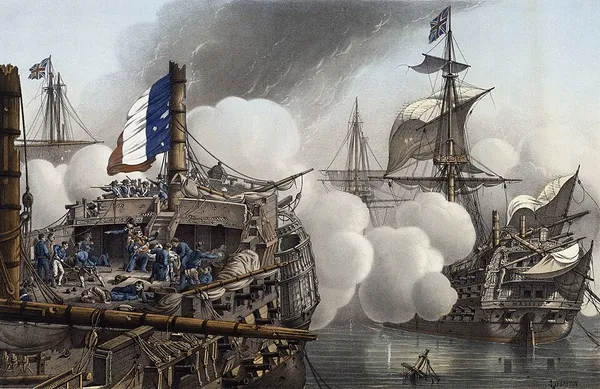
HMS Tonnant (lit. 'Thundering') was an 80-gun ship of the line of the Royal Navy. She had previously been Tonnant of the French Navy and the lead ship of the Tonnant class. The British captured her in August 1793 during the Siege of Toulon but the French recaptured her when the siege was broken in December. Rear-Admiral Horatio Nelson captured her at Aboukir Bay off the coast of Egypt at the Battle of the Nile on 1 August 1798. She was taken into British service as HMS Tonnant. She went on to fight at the Battle of Trafalgar in 1805, during the Napoleonic Wars. During the War of 1812 with the United States, Vice-Admiral Sir Alexander Cochrane assumed command of the North American Station at the end of 1813, and in June 1814 Tonnant became his flagship. On 7 September 1814 Francis Scott Key and John Stuart Skinner dined aboard the ship while seeking the release of a captured civilian prisoner, several days before the Battle of Baltimore. Key went on to write what later became the words to the American national anthem, "The Star-Spangled Banner" after watching the British attack on Baltimore's Fort McHenry. Tonnant was broken up in 1821.
Also on this shelf
HMS Stirling Castle (1679).
HMS Arrow (1796).
See also
Uncatalogued shelfText from Wikipedia; plate via Wikimedia Commons. Text CC BY-SA 4.0; plate freely licensed (see Commons). Source record. Images and catalogue data are reproduced from open-access collections.