Maritime History
Battle of Genoa (1795)
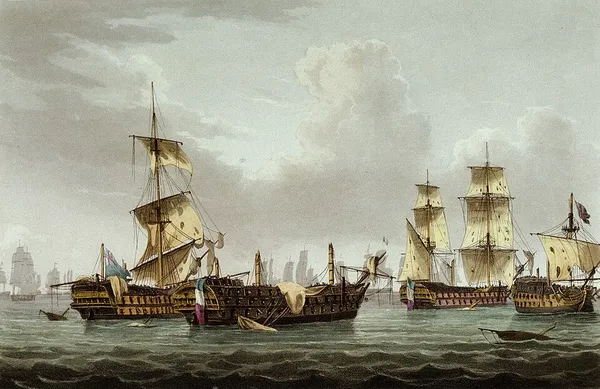
The Battle of Genoa (also known as the Battle of Cape Noli and in French as Bataille de Gênes) was a fleet action fought between an Anglo-Neapolitan fleet and a French fleet on 13-14 March 1795 in the Gulf of Genoa during the Mediterranean campaign of 1793–1796. The French fleet was led by Counter-admiral Pierre Martin and comprised 13 ships of the line while the Anglo-Neapolitan fleet fleet, under Vice-Admiral of the Red William Hotham mustered 13 ships of the line. The battle ended with a minor Anglo-Neapolitan victory and the capture of two French ships of the line. The battle was part of a naval campaign in the spring of 1795, during which Martin sought to assert French control over the waters off Southern France. These had been effectively ceded to the British 18 months earlier when the British captured the French Mediterranean naval base of Toulon. Although it was recaptured at an ensuing siege, the much of the French Navy's Mediterranean Squadron had been burned in the harbour by Anglo-Spanish boarding parties. Only half the Mediterranean Squadron was salvageable and as repairs continued in Toulon, the British used their dominance to invade and capture the island of Corsica in 1794. By the start of 1795 enough French ships were in fighting condition that Martin felt able to make limited cruises in the Ligurian Sea. At the start of March 1795 he sailed for Genoa, encountering and capturing a British ship of the line en route. Off Genoa Martin found himself pursued by Hotham's fleet and, after two days of manoeuvres in calm weather, turned back towards the French coast. Hotham pursued, and on 13 March his leading ships caught the French rearguard. For two days Martin's rearmost ships fought a series of running engagements with the British fleet in which several ships from both sides were badly damaged. Martin's flagship the 120-gun Sans Culotte lost contact with the battle overnight, and after a brief resumption of the battle the following morning he gave orders to withdraw. Two French ships of the line, Ça Ira and Censeur, were left behind, overwhelmed and forced to surrender to the British. Hotham was urged by his subordinate, Captain Horatio Nelson, to continue pursuit, but refused and withdrew his fleet for repairs. One British ship, HMS Illustrious, was later wrecked on the Italian coast.
Also on this shelf
Bornholm.
HMS Berwick (1775).
See also
Uncatalogued shelfText from Wikipedia; plate via Wikimedia Commons. Text CC BY-SA 4.0; plate freely licensed (see Commons). Source record. Images and catalogue data are reproduced from open-access collections.