Maritime History
Dover
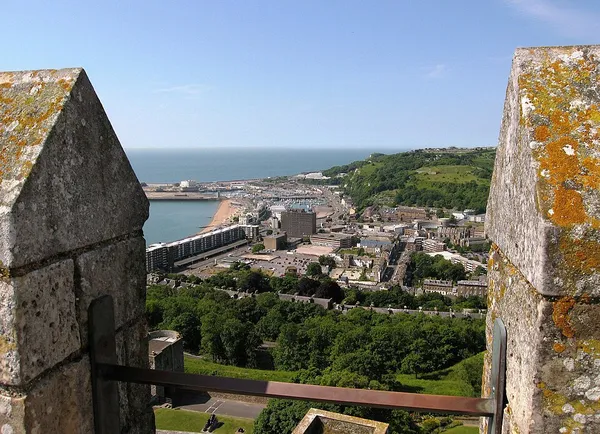
Dover ( DOH-vər) is a town, major ferry port and civil parish in Kent, England. It faces France across the Strait of Dover, the narrowest part of the English Channel at 33 kilometres (21 mi) from Cap Gris-Nez in France. It lies southeast of Canterbury and east of Maidstone. The town is the administrative centre of the Dover District and home of the Port of Dover. In 2024 it had an estimated population of 44,209. Archaeological finds have revealed that the area has always been a focus for peoples entering and leaving Britain. The name derives from the River Dour that flows through it. In recent times the town has undergone transformations, with a high-speed rail link to London, new retail in town with St James' area opened in 2018, and a revamped promenade and beachfront. This followed in 2019, with a new 500 m pier to the west of the harbour, and new marina unveiled as part of a £330 million investment in the area. It has also been a point of destination for many illegal migrant crossings. The Port of Dover provides much of the town's employment, as does tourism, including to the landmark White Cliffs of Dover. There were 368,000 tourists visiting Dover castle in 2019. Dover is classified as a Large-Port Town, due to its large volumes of port traffic and low urban population.
Also on this shelf
Labrador.
Kure Atoll.
See also
Uncatalogued shelfText from Wikipedia; plate via Wikimedia Commons. Text CC BY-SA 4.0; plate freely licensed (see Commons). Source record. Images and catalogue data are reproduced from open-access collections.