Maritime History
Karl Dönitz
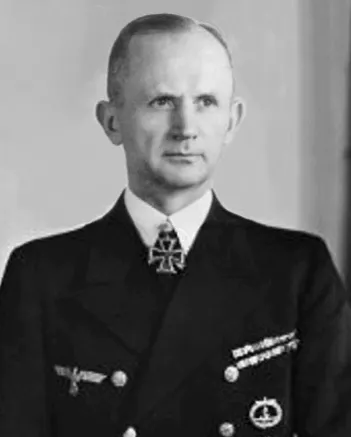
Karl Dönitz (German: [ˈdøːnɪts] ; 16 September 1891 – 24 December 1980) was a German naval officer and politician who briefly succeeded Adolf Hitler as the head of state of Germany in the Nazi era after the latter's suicide during the Second World War in April 1945. He held this position until the dissolution of the Flensburg Government, about two weeks after Germany's unconditional surrender to the Allies. As Supreme Commander of the Navy beginning in 1943, he played a major role in the naval history of the war. He began his career in the Imperial German Navy before the First World War. In 1918, he was commanding UB-68, and was captured as a prisoner of war by British forces. As commander of UB-68, he attacked a convoy in the Mediterranean Sea while on patrol near Malta. Sinking one ship before the rest of the convoy outran his U-boat, Dönitz began to formulate the concept of U-boats operating in attack groups Rudeltaktik (German for "pack tactic", commonly called a "wolfpack") for greater efficiency, rather than operating independently. By the start of the Second World War, Dönitz was supreme commander of the Kriegsmarine's U-boat arm (Befehlshaber der U-Boote [BdU]). In January 1943, he achieved the rank of Großadmiral (grand admiral) and replaced Grand Admiral Erich Raeder as Commander-in-Chief of the Navy. He was the main enemy of Allied naval forces in the Battle of the Atlantic. From 1939 to 1943, the U-boats fought effectively but lost the initiative from May 1943. He ordered his submarines into battle until 1945 to relieve the pressure on other branches of the Wehrmacht (armed forces). 648 U-boats were lost — 429 with no survivors. Furthermore, of these, 215 were lost on their first patrol. Around 30,000 of the 40,000 men who served in U-boats perished. On 30 April 1945, following the suicide of Adolf Hitler and in accordance with his last will and testament, Dönitz was named Hitler's successor as head of state in what became known as the Goebbels cabinet after his second-in-command, Joseph Goebbels, until Goebbels's suicide led to Dönitz's cabinet being reformed into the Flensburg Government instead. On 7 May 1945, he ordered Alfred Jodl, Chief of Operations Staff of the Armed Forces High Command (German: Oberkommando der Wehrmacht (OKW)), to sign the German Instrument of Surrender in Reims, France, formally ending the War in Europe.
Also on this shelf
Bull Island.
Lindau Lighthouse.
See also
Uncatalogued shelfText from Wikipedia; plate via Wikimedia Commons. Text CC BY-SA 4.0; plate freely licensed (see Commons). Source record. Images and catalogue data are reproduced from open-access collections.