Maritime History
HMS Hood
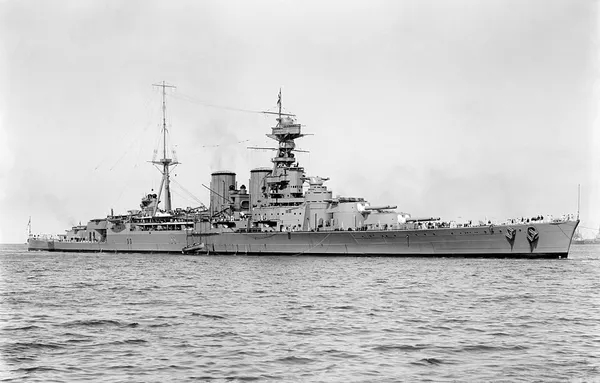
HMS Hood (pennant number 51) was a battlecruiser (sometimes considered a fast battleship) of the Royal Navy (RN). Hood was the first of the planned four Admiral-class battlecruisers to be built during the First World War. She was already under construction when the Battle of Jutland occurred in mid-1916, and that battle revealed serious flaws in her design; with drastic revisions, she was completed four years later. For this reason, she was the only ship of her class to be completed, as the Admiralty decided it would be better to start with a clean design on succeeding battlecruisers, leading to the never-built G-3 class. Despite the appearance of newer and more modern ships, Hood remained the largest warship in the world for 20 years after her commissioning, and her prestige was reflected in her nickname, "The Mighty Hood". Hood was involved in many showing the flag exercises between her commissioning in 1920 and the outbreak of war in 1939, including training exercises in the Mediterranean Sea and a circumnavigation of the globe with the Special Service Squadron in 1923 and 1924. She was attached to the Mediterranean Fleet following the outbreak of the Second Italo-Ethiopian War in 1935. When the Spanish Civil War broke out the following year, Hood was officially assigned to the Mediterranean Fleet until she had to return to Britain in 1939 for an overhaul. By this time, advances in naval gunnery had reduced Hood's usefulness. She was scheduled to undergo a major rebuild in 1941 to correct these issues, but the outbreak of the Second World War in September 1939 kept the ship in service without the upgrades. When war with Germany was declared, Hood was operating in the area around Iceland, and she spent the next several months hunting for German commerce raiders and blockade runners between Iceland and the Norwegian Sea. After a brief overhaul of her propulsion system, she sailed as the flagship of Force H, and participated in the destruction of the French fleet at Mers-el-Kebir. Transferred to the Home Fleet shortly afterwards, Hood was dispatched to Scapa Flow, and operated in the area as a convoy escort and later as a defence against a potential German invasion fleet.
Also on this shelf
Dovercourt.
Aberdeen.
See also
Uncatalogued shelfText from Wikipedia; plate via Wikimedia Commons. Text CC BY-SA 4.0; plate freely licensed (see Commons). Source record. Images and catalogue data are reproduced from open-access collections.