Maritime History
Heptastadion
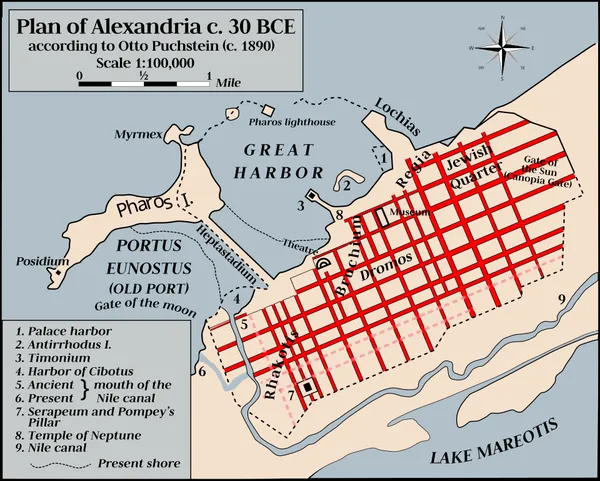
The Heptastadion (Greek: Ὲπταστάδιον) was a giant causeway, often referred to as a mole or a dyke built by the people of Alexandria, Egypt in the 3rd century BC during the Ptolemaic period. The Heptastadion was created to link Pharos Island to the mainland coast and given a name based on its length (Heptastadion is Greek for "seven stadia"— hepta meaning seven, and a stadion being a Greek unit of length measuring approximately 180 m (590 ft)). Overall it was more than three-quarters of a mile long.
Also on this shelf
Darłowo Lighthouse.
HMS Crescent (1931).
See also
Uncatalogued shelfText from Wikipedia; plate via Wikimedia Commons. Text CC BY-SA 4.0; plate freely licensed (see Commons). Source record. Images and catalogue data are reproduced from open-access collections.