Maritime History
Arabian Sea
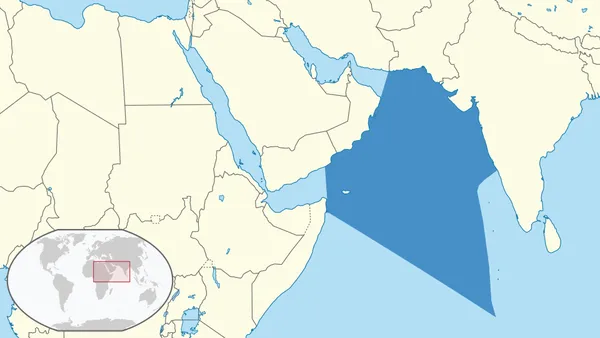
The Arabian Sea (Arabic: بَحرُ ٱلْعَرَبْ, romanized: baḥr al-ʿarab) is a region of sea in the northern Indian Ocean, bounded on the west by the Arabian Peninsula, Gulf of Aden and Guardafui Channel, on the northwest by Gulf of Oman and Iran, on the north by Pakistan, on the east by India, and on the southeast by the Laccadive Sea and the Maldives, and on the southwest by Somalia. Its total area is 3,862,000 km2 (1,491,000 sq mi) and its maximum depth is 5,395 meters (17,700 feet). The Gulf of Aden in the west connects the Arabian Sea to the Red Sea through the strait of Bab-el-Mandeb, and the Gulf of Oman is in the northwest, connecting it to the Persian Gulf. It is dominated in its south and center by the Arabian Basin, an expansive, relatively flat stretch of seabed reaching depths exceeding 4500 meters in some areas. Most islands and seamounts within the sea are located along its coastal fringes, close to major landmasses. The straits of Hormuz and Bab-el Mandeb on the northwestern and western ends of the Arabian Sea have historically served as gateways connecting the kingdoms and polities of the Eastern and Western limits of the Old World since the establishment of the region's first international trade networks in the 3rd millennium BC. This produced countless interdependent nodes of regional commerce all operating in tandem with one another, linking merchants in the Mediterranean with their counterparts in the Near East, who thereafter linked to Persia and East Africa, on to India, Southern Africa, Southeast Asia, East Asia, and the Malay Archipelago. This combined activity facilitated the widespread diffusion of concepts, peoples, philosophies, technologies, religions, specie, and various domesticate variants of crops and livestock across the Old World over millennia, most profoundly from and within the confines of the Indian Ocean and Near Eastern worlds. Trade was historically restricted by the monsoon winds and the currents produced by their interaction with the Indian Ocean Warm Pool. In mid-summer, strong winds carry warm air and moisture northeastwards from the African interior and Indian Ocean, resulting in heavy rains on the northeast shoreline of the Arabian basin, and dry conditions in the Horn of Africa and Arabian Peninsula, though both have seen dramatic fluctuations in their pattern in recent years in favor of more intensive rainfall.
Also on this shelf
Barneville-Carteret.
Dinorwic quarry.
See also
Uncatalogued shelfText from Wikipedia; plate via Wikimedia Commons. Text CC BY-SA 4.0; plate freely licensed (see Commons). Source record. Images and catalogue data are reproduced from open-access collections.