Maritime History
Batavia (1628 ship)
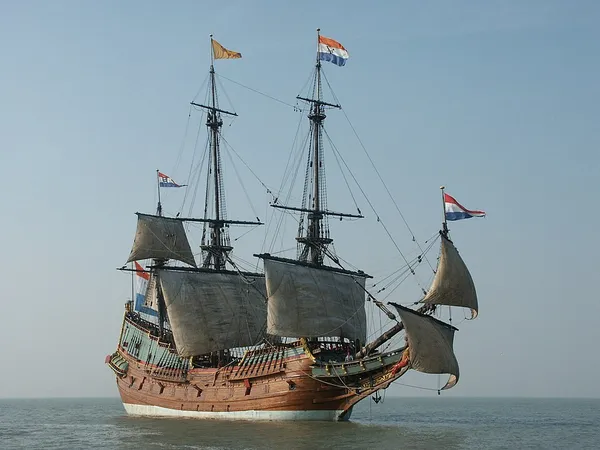
Batavia (Dutch pronunciation: [baːˈtaːvijaː] ) was a ship of the Dutch East India Company (VOC). She was built in Amsterdam in 1628 as the flagship of one of the three annual fleets of company ships and sailed that year on her maiden voyage for Batavia, capital of the Dutch East Indies. On 4 June 1629, Batavia was wrecked on the Houtman Abrolhos, a chain of small islands off Western Australia. As the ship broke apart, approximately 300 of the Batavia's 341 passengers and crew made their way ashore, the rest drowning in their attempts. Her commander, Francisco Pelsaert, sailed nearly 3,000 kilometres (1,900 mi) over 33 days in an open longboat to Batavia, present-day Jakarta, to get help, leaving in charge senior VOC official Jeronimus Cornelisz, unaware the latter had been plotting a mutiny prior to the wreck. Cornelisz tricked about 20 men under soldier Wiebbe Hayes into searching for fresh water on nearby islands, leaving them to die. With the help of other mutineers, he then orchestrated a massacre that, over the course of several weeks, resulted in the murder of approximately 125 of the remaining survivors, including women, children and infants; a small number of women were kept as sex slaves. Meanwhile, Hayes' group had unexpectedly found fresh water and, after learning of the atrocities, waged battles with Cornelisz's group. In October 1629, at the height of their last and deadliest battle, they were interrupted by the return of Pelsaert aboard the rescue vessel Sardam. Pelsaert subsequently tried and convicted Cornelisz and six of his men, who became the first Europeans to be legally executed in Australia. Two other mutineers, convicted of comparatively minor crimes, were marooned on mainland Australia, thus becoming the first Europeans to permanently inhabit the Australian continent, although nothing more was heard of them. Only 122 of the original passengers made it to the port of Batavia. Associated today with "one of the worst horror stories in maritime history", Batavia has been the subject of numerous published histories.
Also on this shelf
Early Caliphate navy.
HMS Phaeton (1782).
See also
Uncatalogued shelfText from Wikipedia; plate via Wikimedia Commons. Text CC BY-SA 4.0; plate freely licensed (see Commons). Source record. Images and catalogue data are reproduced from open-access collections.