Maritime History
Ancient Greek warfare
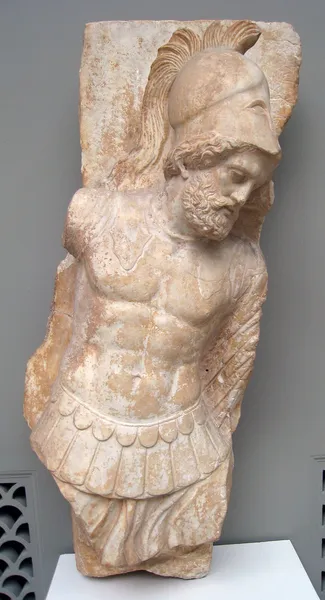
Warfare occurred throughout the history of Ancient Greece, from the Greek Dark Ages onward. The Greek Dark Ages drew to an end as a significant increase in population allowed urbanized culture to be restored, which led to the rise of the city-states (poleis). These developments ushered in the period of Archaic Greece (800–480 BC). They also restored the capability of organized warfare between these poleis (as opposed to small-scale raids to acquire livestock and grain, for example). The fractious nature of Ancient Greek society seems to have made continuous conflict on this larger scale inevitable. Along with the rise of the city-state evolved a new style of warfare: the hoplite phalanx. Hoplites were armored infantrymen, armed with spears and shields. Seen in media, the phalanx was a formation of these soldiers with their shields locked together and spears pointed forward. The Chigi vase, dated to around 650 BC, is the earliest depiction of a hoplite in full battle array. With this evolution in warfare, battles seem to have consisted mostly of the clash of hoplite phalanxes from the city-states in conflict. Since the soldiers were citizens with other occupations, warfare was limited in distance, season and scale. Neither side could afford heavy casualties or sustained campaigns, so conflicts seem to have been resolved by a single set-piece battle. The scope and scale of warfare in Ancient Greece changed as a result of the Greco-Persian Wars, which marked the beginning of Classical Greece (480–323 BC). To battle the enormous armies of the Achaemenid Empire was effectively beyond the capabilities of a single city-state. The eventual triumph of the Greeks was achieved by alliances of many city-states, on a scale and scope never seen before. The rise of the naval power of Athens in competition with the dominant land power of Sparta after this conflict led directly to the Peloponnesian War, which saw diversification of warfare. Emphasis shifted to naval battles and strategies of attrition such as blockades and sieges. Following the defeat of the Athenians in 404 BC, and the disbandment of the Athenian-dominated Delian League, Ancient Greece fell under the Spartan hegemony. But this was unstable, and the Persian Empire sponsored a rebellion by the combined powers of Athens, Thebes, Corinth and Argos, resulting in the Corinthian War (395–387 BC).
Also on this shelf
German submarine U-193.
Chitlapakkam Lake.
See also
Uncatalogued shelfText from Wikipedia; plate via Wikimedia Commons. Text CC BY-SA 4.0; plate freely licensed (see Commons). Source record. Images and catalogue data are reproduced from open-access collections.