Maritime History
Cog (ship)
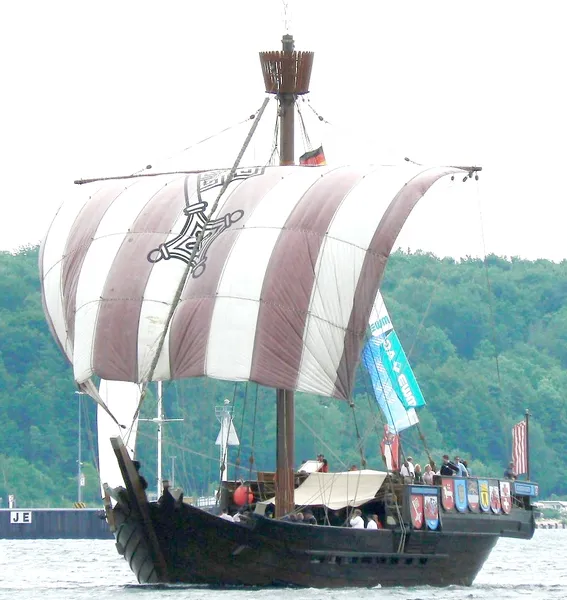
A cog is a type of ship used during the Middle Ages, mostly for trade and transport but also in war. It first appeared in the 10th century, and was widely used from around the 12th century onward. Cogs had clinker-built sides but a flush-planked bottom which was built shell-first. The timber used was, generally, oak. Cogs were fitted with a single mast and a single square sail. They were used primarily for trade in north-west medieval Europe, especially by the Hanseatic League. Typical seagoing cogs were from 15 to 25 metres (49 to 82 ft) long, 5 to 8 metres (16 to 26 ft) wide, and were of 30–200 tons burthen. Cogs were rarely as large as 300 tons, with a few considerably larger at over 1,000 tons. Although the name cog is recorded as early as the 9th century, the seagoing vessel of that name seems to have evolved on the Frisian coast during the 12th century. Cogs progressively replaced Viking-type vessels such as knarrs in northern waters during the 13th century. Cogs could carry more cargo than knarrs of a similar size. Their flat bottoms allowed them to settle level in harbour, making them easier to load and unload. Their high sides made them more difficult to board in a sea fight, which made them safer from pirates.
Also on this shelf
French frigate Aréthuse (1812).
HMS Laforey (G99).
See also
Uncatalogued shelfText from Wikipedia; plate via Wikimedia Commons. Text CC BY-SA 4.0; plate freely licensed (see Commons). Source record. Images and catalogue data are reproduced from open-access collections.