Maritime History
History of the United States Navy
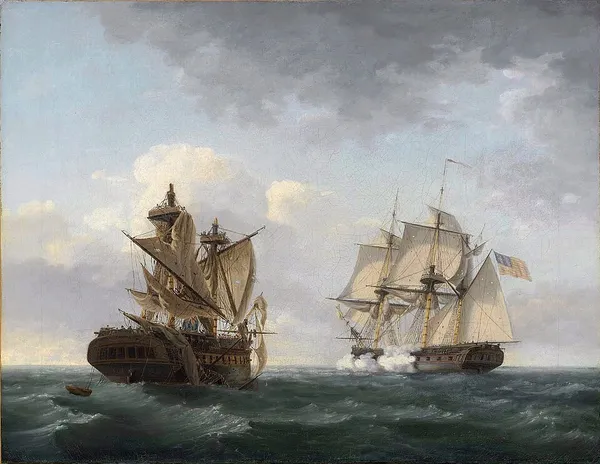
The history of the United States Navy divides into two major periods: the "Old Navy", a small but respected force of sailing ships that became notable for innovation in the use of ironclads during the American Civil War, and the "New Navy" the result of a modernization effort that began in the 1880s and made it the largest in the world by 1943. The United States Navy claims October 13, 1775 as the date of its official establishment, when the Second Continental Congress passed a resolution creating the Continental Navy. With the end of the American Revolutionary War, the Continental Navy was disbanded. Under the Presidency of George Washington, American merchant shipping came under threat from Barbary corsairs, especially after Algerian seizures of American vessels. This led to the Naval Act of 1794, which authorized the original six frigates and reestablished a permanent U.S. Navy.. The original six frigates were authorized as part of the Act. Over the next 20 years, the Navy fought the French Republic Navy in the Quasi-War (1798–99), Barbary states in the First and Second Barbary Wars, and the British in the War of 1812. After the War of 1812, the U.S. Navy was at peace until the Mexican–American War in 1846, and served to combat piracy in the Mediterranean and Caribbean seas, as well as fighting the slave trade off the coast of West Africa. In 1845, the Naval Academy was founded at old Fort Severn at Annapolis, Maryland, by the Chesapeake Bay. In 1861, the American Civil War began and the U.S. Navy fought the small Confederate States Navy with both sailing ships and new revolutionary ironclad ships while forming a blockade that shut down the Confederacy's civilian coastal shipping. After the Civil War, most of its ships were laid up in reserve, and by 1878, the Navy was just 6,000 men. In 1882, the U.S. Navy consisted of many outdated ship designs. Over the next decade, Congress approved building multiple modern steel-hulled armored cruisers and battleships, and by around the start of the 20th century had moved from twelfth place in 1870 to fifth place in terms of numbers of ships. Most sailors were foreigners. After winning two major battles during the 1898 Spanish–American War, the American Navy continued to build more ships, and by the end of World War I had more men and women in uniform than the British Royal Navy.
Also on this shelf
2018 Japan–South Korea radar lock-on dispute.
Autonomous Port of Dakar.
See also
Uncatalogued shelfText from Wikipedia; plate via Wikimedia Commons. Text CC BY-SA 4.0; plate freely licensed (see Commons). Source record. Images and catalogue data are reproduced from open-access collections.