Maritime History
Hanseatic League
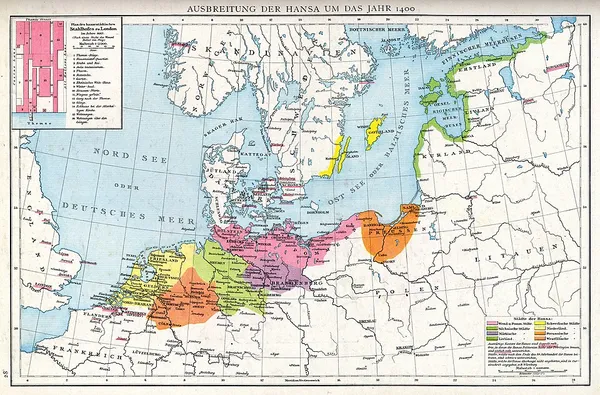
The Hanseatic League, commonly called The Hansa, was a medieval commercial and defensive network of merchant guilds and market towns in Central and Northern Europe. Growing from Lübeck and a few other North German towns in the late 12th century, the league expanded between the 13th and 15th centuries, ultimately encompassing nearly 200 settlements across eight modern-day countries, from Estonia and Russia in the northeast to the Netherlands in the west, with its inland extent reaching as far south as Cologne. The league began as a collection of loosely associated groups of German traders and towns aiming to expand their commercial interests, including protection against robbery. Over time, these arrangements evolved into the league, offering traders toll privileges and protection on affiliated territory and trade routes. Economic interdependence and familial connections among merchant families led to deeper political integration and the reduction of trade barriers. This gradual process involved standardizing trade regulations among Hanseatic cities. During its time, the Hanseatic League dominated maritime trade in the North and Baltic Seas. It established a network of trading posts in numerous towns and cities, notably the Kontors in London (known as the Steelyard), Bruges, Bergen, and Novgorod, which became extraterritorial entities that enjoyed considerable legal autonomy. Hanseatic merchants operated private companies and were known for their access to commodities, and enjoyed privileges and protections abroad. The league's economic power enabled it to impose blockades and even wage war against kingdoms and principalities. Even at its peak, the Hanseatic League remained a loosely aligned confederation of cities. It lacked a permanent administrative body, a treasury, and a standing military force. The Grand Master of the Teutonic Order was often seen as the head of the Hansa (caput Hansae), both abroad and by some League members. The Teutonic Order was an official member of the Hanseatic League, unique as the only autonomous landed state to hold membership, while other members were cities or individual merchants.
Also on this shelf
HMS E18.
Battle of the Kerch Peninsula.
See also
Uncatalogued shelfText from Wikipedia; plate via Wikimedia Commons. Text CC BY-SA 4.0; plate freely licensed (see Commons). Source record. Images and catalogue data are reproduced from open-access collections.