Maritime History
German cruiser Deutschland
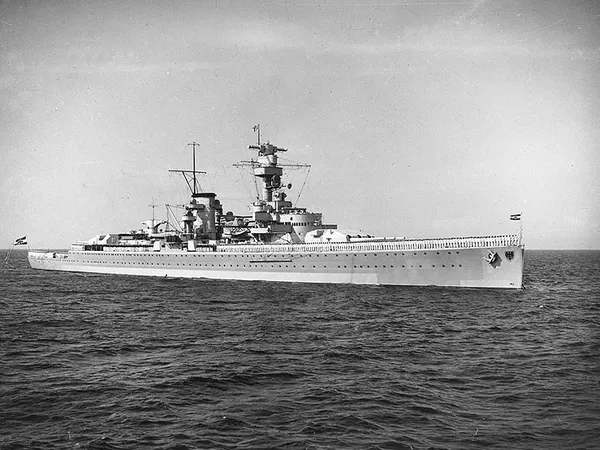
Deutschland was the lead ship of her class of heavy cruisers (often termed pocket battleships) which served with the Kriegsmarine of Nazi Germany during World War II. Ordered by the Weimar government for the Reichsmarine, she was laid down at the Deutsche Werke shipyard in Kiel in February 1929 and completed by April 1933. Originally classified as an armored ship (Panzerschiff) by the Reichsmarine, in February 1940 the Germans reclassified the remaining two ships of this class as heavy cruisers. In 1940, she was renamed Lützow, after the unfinished Admiral Hipper-class heavy cruiser Lützow was sold to the Soviet Union the previous year. The ship saw significant action with the Kriegsmarine, including several non-intervention patrols in the Spanish Civil War, during which she was attacked by Republican bombers in the Deutschland incident. At the outbreak of World War II, she was cruising the North Atlantic, prepared to attack Allied merchant traffic. Bad weather hampered her efforts, and she sank or captured only a handful of vessels before returning to Germany. She then participated in Operation Weserübung, the invasion of Norway. Damaged at the Battle of Drøbak Sound, she was recalled to Germany for repairs. While en route, she was torpedoed and seriously damaged by the British submarine HMS Spearfish. Repairs were completed by March 1941, and in June she left Germany for a commerce raiding operation in the Atlantic. Before reaching the Atlantic, she was torpedoed by a British aircraft and had to return. After repairs, Lützow returned to Norway to join the forces arrayed against Allied shipping to the Soviet Union. She ran aground during Operation Rösselsprung, a planned attack on Convoy PQ 17, and returned to Germany for repairs. She next saw action at the Battle of the Barents Sea with the heavy cruiser Admiral Hipper, which ended with a failure to destroy Convoy JW 51B. Engine problems forced a series of repairs culminating in a complete overhaul at the end of 1943, after which the ship remained in the Baltic as a training ship. In October 1944 Lützow re-entered front line service with Task Force Thiele, participating in shore bombardments of Russian positions in support of the German army.
Also on this shelf
Anholt (island).
Hartland, Devon.
See also
Uncatalogued shelfText from Wikipedia; plate via Wikimedia Commons. Text CC BY-SA 4.0; plate freely licensed (see Commons). Source record. Images and catalogue data are reproduced from open-access collections.