Maps and Exploration
Barn swallow
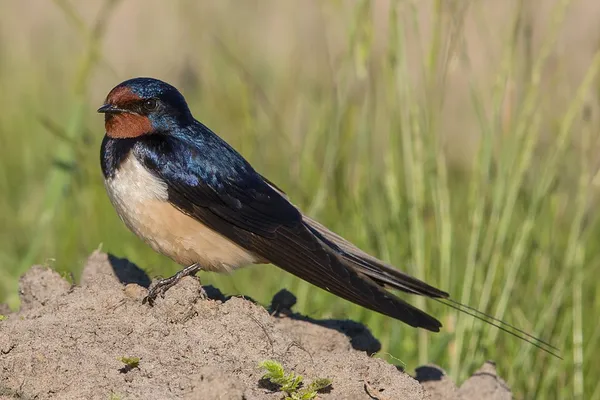
The barn swallow (Hirundo rustica) is the most widespread species of swallow in the world, occurring on all continents, with vagrants reported even in Antarctica. It is a distinctive passerine bird with blue upperparts and a long, deeply forked tail. In Anglophone Europe, it is just called the swallow; in northern Europe, it is the only member of family Hirundinidae called a "swallow" rather than a "martin". There are eight subspecies of barn swallow, which breed across the Northern Hemisphere. Two subspecies (H. r. savignii and H. r. transitiva) have fairly restricted ranges in the Nile valley and eastern Mediterranean, respectively. The other six are more widespread, with winter ranges covering much of the Southern Hemisphere. The barn swallow is a bird of open country that normally nests in man-made structures and consequently has spread with human expansion. It builds a cup nest from mud pellets in barns or similar structures and feeds on insects caught in flight. This species lives in close association with humans, and its insect-eating habits mean that it is tolerated by humans; this acceptance was reinforced in the past by superstitions regarding the bird and its nest. There are frequent cultural references to the barn swallow in literary and religious works due to both its living in close proximity to humans and its annual migration. The barn swallow is the national bird of Austria and Estonia.
Also on this shelf
Dogs of the Australasian Antarctic Expedition.
Lincoln Acres, California.
See also
Uncatalogued shelfText from Wikipedia; plate via Wikimedia Commons. Text CC BY-SA 4.0; plate freely licensed (see Commons). Source record. Images and catalogue data are reproduced from open-access collections.