Maps and Exploration
Geography of Scotland
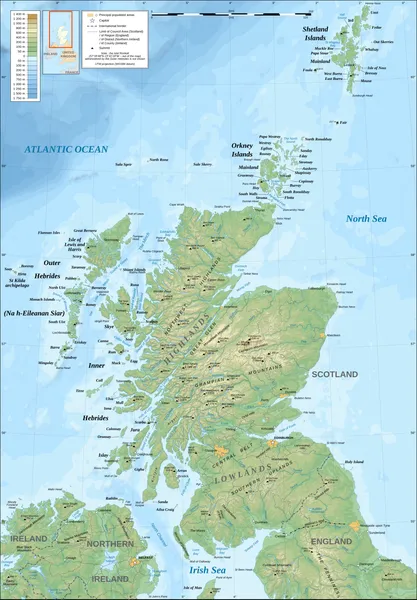
The geography of Scotland is varied from rural lowlands to unspoilt uplands, and from large cities to sparsely inhabited islands. Located in Northern Europe, Scotland comprises the northern part of the island of Great Britain as well as 790 surrounding islands encompassing the major archipelagos of the Shetland Islands, Orkney Islands and the Inner and Outer Hebrides. The only land border is with England, which runs for 96 miles (154 kilometres) in a northeasternly direction from the Solway Firth in the west to the North Sea on the east coast. Separated by the North Channel, the island of Ireland lies 13 nautical miles (24 kilometres) from Mull of Kintyre on the Scottish mainland. Norway is located 190 nmi (350 km) northeast of Scotland across the North Sea. The Atlantic Ocean, which fringes the coastline of western and northern Scotland and its islands, influences the temperate, maritime climate of the country. Scotland contains the majority of mountainous terrain in the UK. The topography of Scotland is distinguished by the Highland Boundary Fault which traverses the Scottish mainland from Helensburgh to Stonehaven. The faultline separates two distinctively different physiographic regions; namely the Highlands to the north and west and the Lowlands to the south and east. The more rugged Highland region contains the majority of Scotland's mountainous terrain, including the highest peak, Ben Nevis. Lowland areas, in the southern part of Scotland, are less mountainous and home to most of the population, especially the narrow waist of land between the Firth of Clyde and the Firth of Forth known as the Central Belt. Glasgow is the largest city in Scotland, although Edinburgh is the capital and political centre of the country. While the Lowlands are less elevated, upland and mountainous terrain is located across the Southern Uplands. An abundance of natural resources such as coal, iron and zinc contributed significantly to the industrial growth of Scotland during the 19th and early 20th centuries. Today, energy is a major component of Scotland's economy. Whilst Scotland is a large producer of petroleum, the production potential of renewable energy has emerged as an important economic and environmental issue in recent years.
Also on this shelf
Island of California.
City Canal.
See also
Uncatalogued shelfText from Wikipedia; plate via Wikimedia Commons. Text CC BY-SA 4.0; plate freely licensed (see Commons). Source record. Images and catalogue data are reproduced from open-access collections.