Maps and Exploration
Demographics of Turkey
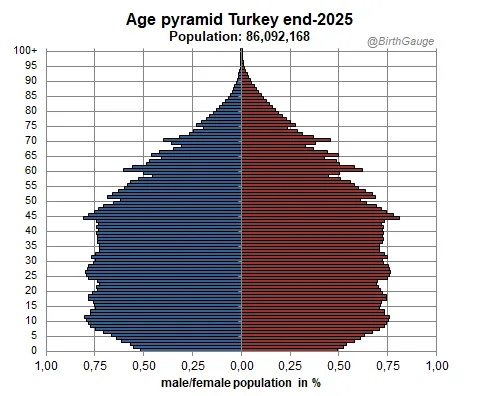
Demographic features of the population of Turkey include population density, ethnicity, education level, health of the populace, economic status, religious affiliations and other aspects of the population. Its estimated population was 86,092,168, of which 1,519,515 were foreign residents as of 31 December 2025, according to the Turkish Statistical Institute. This official population number excludes the registered Syrian refugees under temporary protection status which have a population of about 2.21 million as of 3 September 2026. Turks are the largest ethnic group, comprising 70–75% of the population while Kurds are the second largest with 19%. The others, including Armenians, Arabs, Assyrians, Albanians, Bulgarians, Bosniaks, Circassians, Chechens, Crimean Tatars, Georgians, Greeks, Hemshins, Jews, Laz people, Pomaks, Rum, Russians, Romani and others make 6–11% of the population according to a 2016 estimate by the CIA. The population has been aging in recent years, with just 20.4% falling in the 0–14 age bracket (down from 26.4% in 2007). The population over the age of 65 is 11.1% (up from 7.1% in 2007). As of 2025, the median age of the Turkish population is 34.9 years (up from 28.3 in 2007). According to OECD/World Bank population statistics, from 1990 to 2008 the population growth in Turkey was 16 million or 29%.
Also on this shelf
Addis Ababa.
Effects of climate change.
See also
Uncatalogued shelfText from Wikipedia; plate via Wikimedia Commons. Text CC BY-SA 4.0; plate freely licensed (see Commons). Source record. Images and catalogue data are reproduced from open-access collections.