Maps and Exploration
History of slavery in the Muslim world
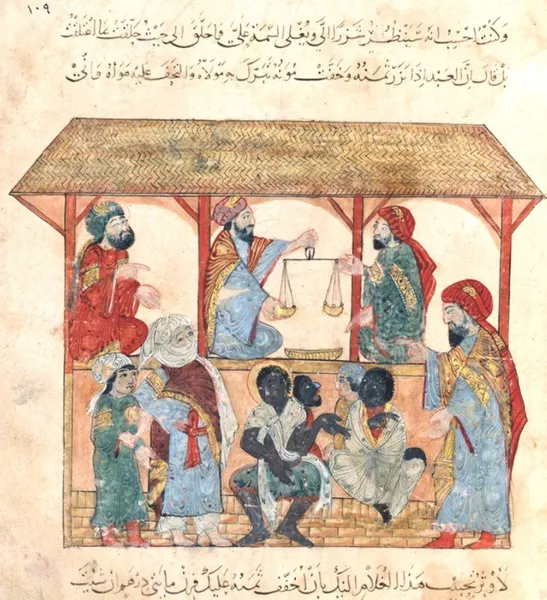
The history of slavery in the Muslim world was throughout the history of Islam with slaves serving in various social and economic roles, from powerful emirs to harshly treated manual laborers. Slaves were widely used in labour in irrigation, mining, and animal husbandry, but most commonly as soldiers, guards, and domestic workers. The use of slaves for hard physical labor early on in Muslim history led to several destructive slave revolts, the most notable being the Zanj Rebellion of 869–883. Many rulers also used slaves in the military and administration to such an extent that slaves could seize power, as did the Mamluks. Most slaves were imported from outside the Muslim world. Slavery in the Muslim world did not have a racial foundation in principle, although this was not always the case in practice. The Arab slave trade was most active in West Asia, North Africa (Trans-Saharan slave trade), and Southeast Africa (Red Sea slave trade and Indian Ocean slave trade), and rough estimates place the number of Africans enslaved in the twelve centuries prior to the 20th century at between six million to ten million. The Ottoman slave trade came from raids into eastern and central Europe and the Caucasus connected to the Crimean slave trade, while slave traders from the Barbary Coast raided the Mediterranean coasts of Europe and as far afield as the British Isles and Iceland. Historically, Muslim West Asia was more or less united for many centuries, and slavery was hence reflected in the institution of slavery in the Rashidun Caliphate (632–661), slavery in the Umayyad Caliphate (661–750), slavery in the Abbasid Caliphate (750–1258), slavery in the Mamluk Sultanate (1258–1517) and slavery in the Ottoman Empire (1517–1922), before slavery was finally abolished in one Muslim country after another during the 20th century. In the 20th century, the authorities in Muslim states gradually outlawed and suppressed slavery. Slavery in Zanzibar was abolished in 1909, when slave concubines were freed, and the open slave market in Morocco was closed in 1922. Slavery in the Ottoman Empire was abolished in 1924 when the new Turkish Constitution disbanded the Imperial Harem and made the last concubines and eunuchs free citizens of the newly proclaimed republic. Slavery in Iran and slavery in Jordan were abolished in 1929.
Also on this shelf
Drifting ice station.
Chinnakada Clock Tower.
See also
Uncatalogued shelfText from Wikipedia; plate via Wikimedia Commons. Text CC BY-SA 4.0; plate freely licensed (see Commons). Source record. Images and catalogue data are reproduced from open-access collections.