Maps and Exploration
Basal ganglia
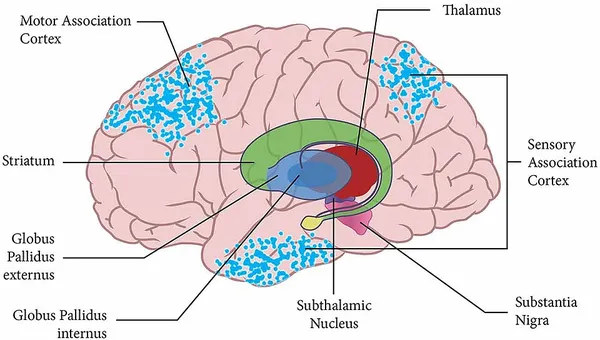
The basal ganglia (BG) or basal nuclei are a group of subcortical nuclei (cluster of neurons) found in the brains of vertebrates. Positioned at the base of the forebrain and the top of the midbrain, they have strong connections with the cerebral cortex, thalamus, brainstem and other brain areas. The basal ganglia are associated with a variety of functions, including regulating voluntary motor movements, procedural learning, habit formation, conditional learning, eye movements, cognition, and emotion. The main functional components of the basal ganglia include the striatum, consisting of both the dorsal striatum (caudate nucleus and putamen) and the ventral striatum (nucleus accumbens and olfactory tubercle), the globus pallidus, the ventral pallidum, the substantia nigra, and the subthalamic nucleus. Each of these components has complex internal anatomical and neurochemical structures. The largest component, the striatum (dorsal and ventral), receives input from various brain areas but only sends output to other components of the basal ganglia. The globus pallidus receives input from the striatum and sends inhibitory output to a number of motor-related areas. The substantia nigra is the source of the striatal input of the neurotransmitter dopamine, which plays an important role in basal ganglia function. The subthalamic nucleus mainly receives input from the striatum and cerebral cortex and projects to the globus pallidus. The basal ganglia are thought to play a key role in action selection, aiding in the choice of behaviors to execute. More specifically, they regulate motor and premotor cortical areas, facilitating smooth voluntary movements. Experimental studies show that the basal ganglia exert an inhibitory influence on a number of motor systems, and that a release of this inhibition permits a motor system to become active. The "behavior switching" that takes place within the basal ganglia is influenced by signals from many parts of the brain, including the prefrontal cortex, which plays a key role in executive functions. It has also been hypothesized that the basal ganglia are not only responsible for motor action selection, but also for the selection of more cognitive actions. Computational models of action selection in the basal ganglia incorporate this. The basal ganglia are of major importance for normal brain function and behaviour.
Also on this shelf
Black River Academy.
Adirondack Park.
See also
Uncatalogued shelfText from Wikipedia; plate via Wikimedia Commons. Text CC BY-SA 4.0; plate freely licensed (see Commons). Source record. Images and catalogue data are reproduced from open-access collections.