Maps and Exploration
French Pavilion of Versailles
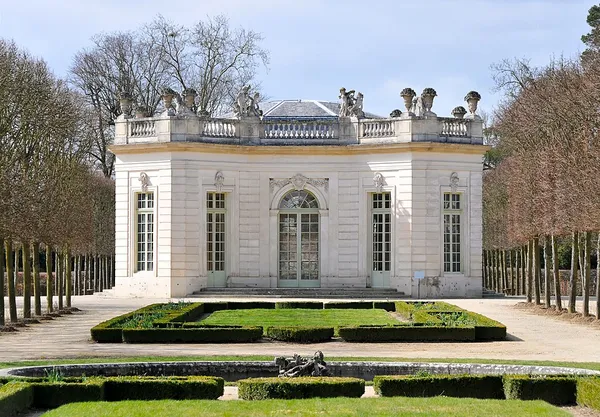
The French Pavilion was built for Louis XV and Madame de Pompadour by Ange-Jacques Gabriel in the French Garden of the Petit Trianon, in the grounds of the Château de Versailles. Built in 1750, this pavilion is set in the heart of the formal garden, and its high French windows open onto its views. At once the centre and a natural extension of the "king's new garden", created to distract him from his melancholy, it serves as a music salon, a place for games and conversation. It is considered a masterpiece of balance between nobility and fantasy. Its original layout is based on an octagonal drawing room flanked by four small square cabinets arranged in a cross. Jules-Antoine Rousseau's mascarons depicting the seasons adorn the cross-shaped windows on the stone facades. The balustrade is decorated with eight groups of children, allegories of the four seasons and the four elements, and eight vases of flowers by the same sculptor. The circular drawing room is decorated with carved panelling by Jacques Verbeckt, formerly covered in pastel colours to match the country atmosphere and now in gilding. Eight Corinthian columns support a cornice decorated with a variety of gallinaceous animals, a reference to the nearby domestic menagerie. Turned into a café during the French Revolution, it once again became a party venue under the Empire, as it had been under the Ancien Régime, before slowly falling into disrepair. It underwent an initial restoration campaign at the end of the 19th century, which did little to restore it to its original state, before being completely restored in 2008. Classified with the Château de Versailles and its outbuildings as a historic monument by the list of 1862 and by decree of 31 October 1906.: it is open to the public as part of the Musée National des Châteaux de Versailles et de Trianon, within the Domaine de Marie-Antoinette.
Also on this shelf
Goiânia accident.
Burnie Theatre.
See also
Uncatalogued shelfText from Wikipedia; plate via Wikimedia Commons. Text CC BY-SA 4.0; plate freely licensed (see Commons). Source record. Images and catalogue data are reproduced from open-access collections.