Maps and Exploration
Demographics of India
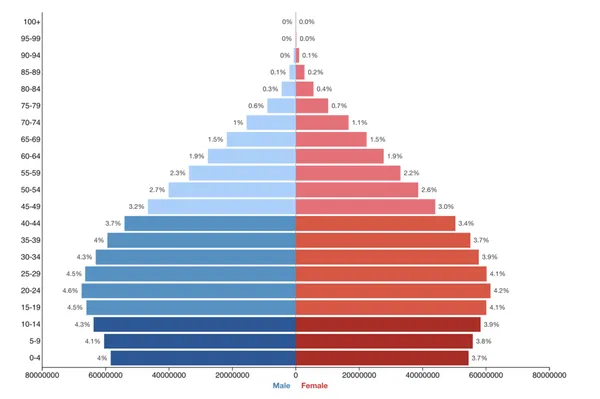
India is the most populous country in the world, comprising approximately one-sixth of the world population. According to the United Nations' World Population Dashboard, India's population reached slightly over 1.428 billion on 1 July 2023, surpassing that of China. India remains a relatively young country, though it is undergoing a gradual demographic transition. As of 2024, the median age was approximately 29.8 years, compared to 40.2 in China. The United Nations Population Fund (UNFPA) estimates that 68% of the population is between 15 and 64 years old, creating a potential "demographic dividend" where a large working-age population can drive economic growth. However, the number of children is declining; the under-5 population peaked in 2007 and the under-15 cohort peaked in 2011. Between 1975 and 2010, the population doubled to 1.2 billion. While the population continues to grow, the rate has slowed significantly from 2.3% annually (1972–1983) to roughly 0.89% in 2023. Current projections suggest the population will reach 1.7 billion by 2050. India is highly diverse, hosting thousands of ethnic groups and four major language families: Indo-European, Dravidian, Austroasiatic, and Tibeto-Burman. The country also includes linguistic isolates such as Nihali and Burushaski, and distinct minority communities including Anglo-Indians and Siddi. The human sex ratio has shown an upward trend after decades of decline, reaching 943 females per 1,000 males in 2011 and estimated at 1,060 males per 1,000 females (approx. 944 females/1000 males) in 2023.
Also on this shelf
Berkley, Michigan.
Andrzej Zawada.
See also
Uncatalogued shelfText from Wikipedia; plate via Wikimedia Commons. Text CC BY-SA 4.0; plate freely licensed (see Commons). Source record. Images and catalogue data are reproduced from open-access collections.