Maps and Exploration
2008 Summer Olympics opening ceremony
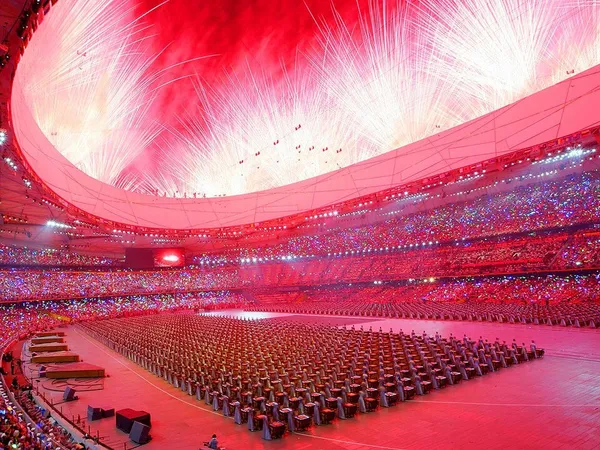
The opening ceremony of the 2008 Summer Olympics was held at the Beijing National Stadium, also known as the Bird's Nest. It began at 20:00 (8:00 PM) China Standard Time (UTC+08:00), on 8 August 2008, due to the significance of the number 8, which is considered to be auspicious and is furthermore associated with prosperity and confidence in Chinese culture. The artistic part of the ceremony comprised two parts titled "Brilliant Civilization" and "Glorious Era" respectively. The first part highlighted Chinese civilization and the second part exhibited modern China and its dream of harmony between the people of the world. The stadium was full to its 91,000 capacity according to organizers. The ceremony was directed by Chinese filmmaker Zhang Yimou, who was the chief director, and whose international reputation rests partly on work banned in China. He was assisted by Chinese choreographers Zhang Jigang and Chen Weiya. The director of music for the ceremony was composer Chen Qigang. It was noted for its focus on ancient Chinese culture (with the Communist revolution being largely omitted). The final ascent to the torch featured Olympic gymnast Li Ning, who appeared to run through air around the membrane of the stadium. Featuring 15,000 performers, the ceremony lasted over four hours (4:09, second only to Sydney 2000) and was reported to have cost over US$100 million to produce. The Ceremony was also notable for using weather modification technology to prevent rainfall. Using cloud seeding, the government ordered over 1000 misses filled with silver iodide to surround the city. They were assisted by three aircraft. The goal was to cause potential storms to release the rain before it reached the stadium. The opening ceremony was broadly praised by the international press as spectacular, and as the best ever Olympic opening ceremony. It drew rave reviews despite controversy, and a worldwide TV audience variously estimated, but likely over a billion. The ceremonies were also criticised for their militarism, high cost, historical revisionism, and lack of humour. The opening ceremony can also be considered an important branding initiative for China. In 2014, the Beijing Olympics opening ceremony and Zhang Yimou were collectively awarded a Peabody Award for the "spell-binding, unforgettable celebration of the Olympic promise".
Also on this shelf
Edgar Evans.
History of longitude.
See also
Uncatalogued shelfText from Wikipedia; plate via Wikimedia Commons. Text CC BY-SA 4.0; plate freely licensed (see Commons). Source record. Images and catalogue data are reproduced from open-access collections.