Maps and Exploration
Climate of Argentina
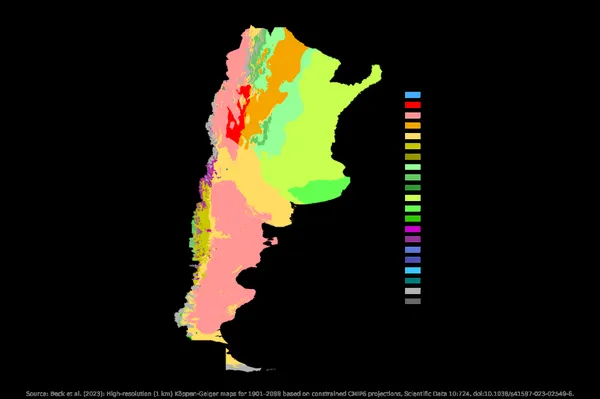
The climate of Argentina varies from region to region, as the vast size of the country and wide variation in altitude make for a wide range of climate types. Summers are the warmest and wettest season in most of Argentina, except for most of Patagonia, where it is the driest season. The climate is warm and tropical in the north, mild in the center, and cold in the southern parts, that experience frequent frost and snow. Because the southern parts of the country are moderated by the surrounding oceans, the cold is less intense and prolonged than areas at similar latitudes in the Northern Hemisphere. Spring and autumn are transition seasons that generally feature mild weather. Many regions have different, often contrasting microclimates. In general, the northern parts of the country are characterized by hot, humid, rainy summers and mild winters with periodic droughts. Mesopotamia, in the northeast is characterized by high temperatures and abundant precipitation throughout the year with droughts being uncommon. West of this lies the Chaco region, which is the warmest region in Argentina. Precipitation in the Chaco region decreases westwards, resulting in the vegetation changing from forests in the east to shrubs in the west. Northwest Argentina is predominantly dry and hot although the rugged topography makes it climatically diverse, ranging from the cold, dry Puna to thick jungles. The center of the country, which includes the Pampas to the east and the drier Cuyo region to the west has hot summers with frequent tornadoes and thunderstorms, and cool, dry winters. Patagonia, in the southern parts of the country has a dry climate with warm summers and cold winters characterized by strong winds throughout the year and one of the strongest precipitation gradients in the world. High elevations at all latitudes experience cooler conditions, and the mountainous zones can see heavy snowfall. The geographic and geomorphic characteristics of Argentina tend to create extreme weather conditions, often leading to natural disasters that negatively impact the country both economically and socially. The Pampas, where many of the large cities are located, has a flat topography and poor water drainage, making it vulnerable to flooding.
Also on this shelf
Australasian Antarctic Expedition.
Ban Phou Pheung Noi.
See also
Uncatalogued shelfText from Wikipedia; plate via Wikimedia Commons. Text CC BY-SA 4.0; plate freely licensed (see Commons). Source record. Images and catalogue data are reproduced from open-access collections.