Maps and Exploration
Antarctic ice sheet
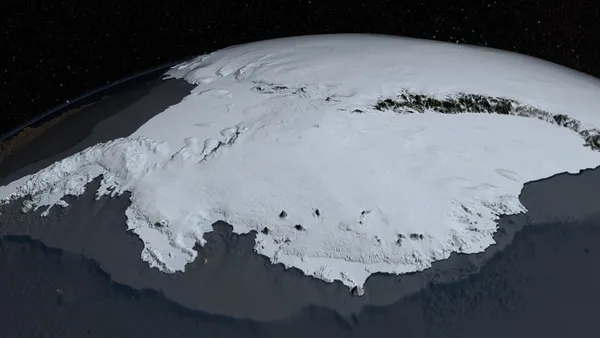
The Antarctic ice sheet is a continental glacier covering 98% of the Antarctic continent, with an area of 14 million square kilometres (5.4 million square miles) and an average thickness of over 2 kilometres (1.2 mi). It is the largest of Earth's two current ice sheets, containing 26.5 million cubic kilometres (6,400,000 cubic miles) of ice, which is equivalent to 61% of all fresh water on Earth. Its surface is nearly continuous, and the only ice-free areas on the continent are the dry valleys, nunataks of the Antarctic mountain ranges, and sparse coastal bedrock. It is often subdivided into the Antarctic Peninsula (AP), the East Antarctic Ice Sheet (EAIS), and the West Antarctic Ice Sheet (WAIS), due to the large differences in glacier mass balance, ice flow, and topography between the three regions. Because the East Antarctic Ice Sheet is over 10 times larger than the West Antarctic Ice Sheet and located at a higher elevation, it is less vulnerable to climate change than the WAIS. In the 20th century, EAIS had been one of the only places on Earth which displayed limited cooling instead of warming, even as the WAIS warmed by over 0.1 °C/decade from 1950s to 2000, with an average warming trend of >0.05 °C/decade since 1957 across the whole continent. As of early 2020s, there is still net mass gain over the EAIS (due to increased precipitation freezing on top of the ice sheet), yet the ice loss from the WAIS glaciers such as Thwaites and Pine Island Glacier is far greater. By 2100, net ice loss from Antarctica alone would add around 11 cm (5 in) to the global sea level rise. Further, the way WAIS is located deep below the sea level leaves it vulnerable to marine ice sheet instability, which is difficult to simulate in ice-sheet models. If instability is triggered before 2100, it has the potential to increase total sea level rise caused by Antarctica by tens of centimeters more, particularly with high overall warming. Ice loss from Antarctica also generates fresh meltwater, at a rate of 1100–1500 billion tons (GT) per year.
Also on this shelf
Arena Zagreb.
François Levaillant.
See also
Uncatalogued shelfText from Wikipedia; plate via Wikimedia Commons. Text CC BY-SA 4.0; plate freely licensed (see Commons). Source record. Images and catalogue data are reproduced from open-access collections.