Maps and Exploration
Arequipa
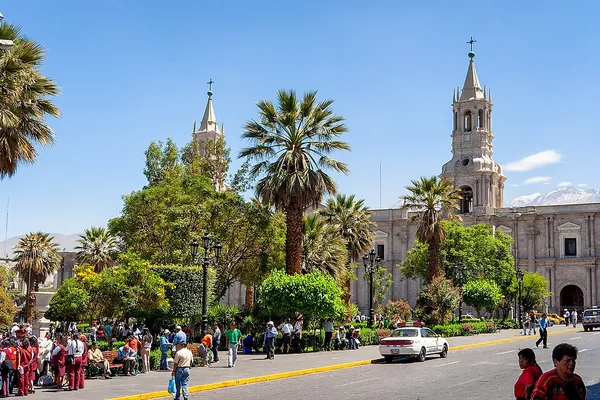
Arequipa is a city in southern Peru and the capital of Arequipa Province and the Department of Arequipa. With a projected population of 1,195,700 in 2025, it is the country's second most populous city after Lima. It is the official seat of the Constitutional Court of Peru and is known as the "Legal Capital of Peru". Arequipa joined the UNESCO Global Network of Learning Cities in 2020. Arequipa extends along both banks of the Chili River, in the Arequipa or Chili valley. The valley is bordered by the Andes to the north and east and by low coastal hills to the south and west. The city proper extends mainly over 14 districts, while the Arequipa metropolitan area includes 21 conurbated districts. The site of the city was founded on 15 August 1540, when it was named "Villa Hermosa de Nuestra Señora de la Asunta de Arequipa". On 25 September 1541, by a real cédula issued by Charles V, it became the "City of Arequipa". During the viceregal period, Arequipa gained importance through its economic role and its loyalty to the Spanish monarchy. Arequipa is Peru's second most industrialized city and one of its most economically active urban centers. In 2024 the Department of Arequipa recorded a nominal GDP of S/31.458 billion and GDP per capita of S/19,593, making it the country's second-largest regional economy. Because the capital city concentrates much of the department's economic activity, the departmental figure provides broad macroeconomic context for the city. A 2015 study estimated the city's own GDP at US$9.445 billion. Its industrial activity includes manufactured goods, textiles made from wool of camelids, and the production and sale of copper and molybdenum concentrates. The city maintains commercial links with Chile, Bolivia and Brazil, and is connected by the Southern Railway with the port of Matarani and the cities of Cusco and Puno. After independence, the city gained political and economic importance. During the 19th and 20th centuries it acted as a counterweight to centralized power in Lima, functioning as a "second capital". It was a focus of popular, civic and democratic rebellions and produced prominent figures in politics and religion. Arequipa was the scene of more than seven uprisings or revolutions between independence and 1850 and twice served as the seat of the national government.
Also on this shelf
Banate, Iloilo.
History of slavery in the Muslim world.
See also
Uncatalogued shelfText from Wikipedia; plate via Wikimedia Commons. Text CC BY-SA 4.0; plate freely licensed (see Commons). Source record. Images and catalogue data are reproduced from open-access collections.