Maps and Exploration
Argentine Antarctica
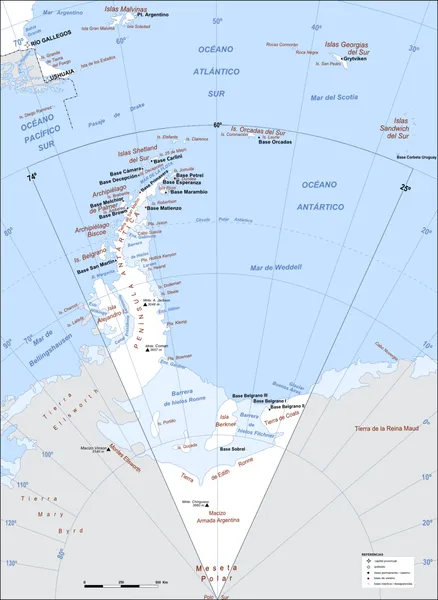
Argentine Antarctica (Spanish: Antártida Argentina or Sector Antártico Argentino) is an area on Antarctica claimed by Argentina as part of its national territory. It consists of the Antarctic Peninsula and a triangular section extending to the South Pole, delimited by the 25° West and 74° West meridians and the 60° South parallel. This region overlaps with British and Chilean claims in Antarctica. None of these claims have widespread international recognition. Argentina's Antarctic claim is based on its presence on a base on Laurie Island in the South Orkney Islands since 1904, along with the area's proximity to the South American continent, and is subject to the Antarctic Treaty; however, the presence on the Antarctic mainland was established in 1951, and the official claim on the mainland was started to be formulated on 1941, with several changes and was officially declared on 1957. Administratively, Argentine Antarctica is a department of the province of Tierra del Fuego, Antarctica, and South Atlantic Islands. The provincial authorities are based in Ushuaia. Argentine activities in Antarctica are coordinated by the Instituto Antártico Argentino (IAA) and Argentine Antarctic Program. The Argentine exploration of the continent started early in the 20th century. José María Sobral was the first Argentine to set foot on Antarctica in 1902, where he spent two seasons with the Swedish Antarctic Expedition of Otto Nordenskiöld. Shortly afterward, in 1904, the Orcadas Permanent Base was established. Years later, other permanent and seasonal bases were constructed. The first Argentine expedition to reach the South Pole was the 1965 Operación 90. The estimated area of Argentine Antarctica is 1,461,597 km2 (564,326 sq mi), of which 965,597 km2 (372,819 sq mi) is land. The ice of the glaciers over the territory's surface has an average thickness of 2 kilometres (1¼ miles). Temperatures fall in a typical range from 0 °C (32 °F) in summer to −60 °C (−76 °F) in winter, although in certain points the temperature may drop to as low as −82 °C (−115 °F) and may rise to 18 °C (65 °F). Time zone UTC-3 is used in the area, as in Argentina. Argentina has six permanent Antarctic stations and seven summer stations.
Also on this shelf
Hume MRT station.
David Livingstone.
See also
Uncatalogued shelfText from Wikipedia; plate via Wikimedia Commons. Text CC BY-SA 4.0; plate freely licensed (see Commons). Source record. Images and catalogue data are reproduced from open-access collections.