Maps and Exploration
History of Hawaii
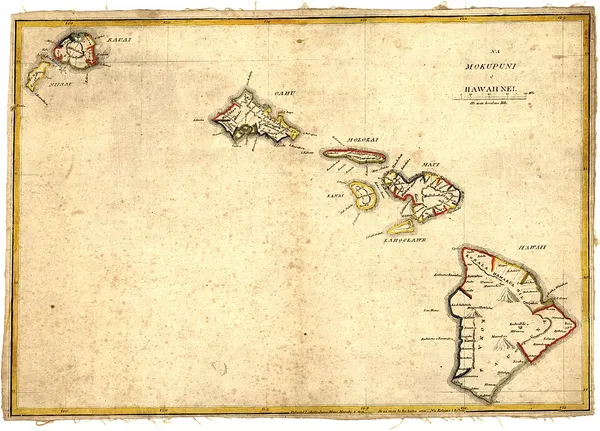
The history of Hawaii began with the arrival of Polynesian peoples to the Hawaiian Islands between 940 and 1200 AD. The islands' history is marked by a slow, steady growth in population and the size of the chiefdoms, which grew to encompass whole islands. Local chiefs, called aliʻi, ruled their settlements, and launched wars to extend their influence and defend their communities from predatory rivals. Ancient Hawaiʻi was a caste-based society, much like that of Hindus in India. Population growth was facilitated by ecological and agricultural practices that combined upland agriculture (mauka), ocean fishing (makai), fishponds and gardening systems. These systems were upheld by spiritual and religious beliefs, like the lokahi, that linked cultural continuity with the health of the natural world. According to Hawaiian scholar Mililani Trask, the lokahi symbolizes the "greatest of the traditions, values, and practices of our people ... There are three points in the triangle—the Creator, Akua; the peoples of the earth, Kanaka Maoli; and the land, the ʻaina. These three things all have a reciprocal relationship." In January 1778, Great Britain and the Hawaiians came into contact when explorer James Cook and his crew sighted the islands during his third voyage of exploration. This became the first recorded and sustained contact between Europeans and Hawaiians. This had a significant impact on Hawaii, even in this initial limited interaction, introducing firearms to Hawaiian warfare. Aided by firearms and ships, Kamehameha I conquered and unified most of the islands in 1795, establishing the Kingdom of Hawaii. The unification was completed in 1810 when Kauaʻi and Niʻihau voluntarily joined the kingdom. This event marked the end of the long tradition of warfare among rival chiefs. The Kingdom was an internationally recognized sovereign state, being recognized by the United States, Japan, Great Britain, France, Spain, and other powers through treaties and diplomatic exchanges beginning in the 1820s. The United States signed its first treaty with Hawaii on December 23, 1826; France followed on July 17, 1839. The kingdom became prosperous and important for its agriculture and strategic location in the Pacific. The group of islands did not have a single name, and each island was ruled separately. The names of the islands recorded by Captain Cook reflect this fact.
Also on this shelf
Dell'Arcano del Mare.
2012 United States presidential election in Minnesota.
See also
Uncatalogued shelfText from Wikipedia; plate via Wikimedia Commons. Text CC BY-SA 4.0; plate freely licensed (see Commons). Source record. Images and catalogue data are reproduced from open-access collections.