Maps and Exploration
Copacabana Fort revolt
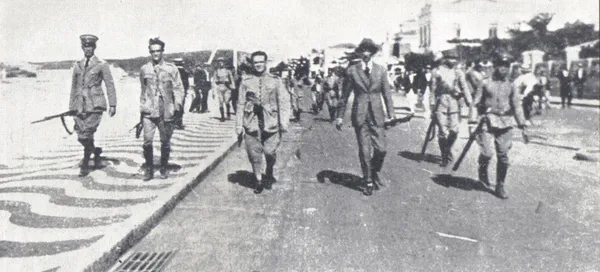
The Copacabana Fort revolt (Portuguese: Revolta do Forte de Copacabana), also known as the 18 of the Fort revolt (Revolta dos 18 do Forte), was one of several movements coordinated by rebel factions of the Brazilian Army against the president of Brazil, Epitácio Pessoa, and the winner of the 1922 presidential election, Artur Bernardes. Acting under the figure of marshal Hermes da Fonseca and supporting the defeated faction, the Republican Reaction, the rebels tried a wide revolt in Rio de Janeiro on 5 July 1922, but only managed to control Fort Copacabana and the Military School of Realengo, in addition to, outside the city, a focus in Niterói and the 1st Military Circumscription, in Mato Grosso. They were defeated, but the revolt marks the beginning of tenentism and the events that led to the end of the First Brazilian Republic. In 1921, Nilo Peçanha launched himself as an opposition presidential candidate, aligning the oligarchies of second-tier states against the domination of Brazilian politics by the most powerful states of São Paulo and Minas Gerais. Peçanha garnered the support of dissident military members gathered around Hermes da Fonseca, president of the Military Club. In October, fake letters attributed to Artur Bernardes insulting the military stirred up the election and prompted them to actively participate in the campaign. The rigged electoral system ensured Bernardes' victory in March 1922. The opposition contested the results and over the following months a military conspiracy emerged across the country to remove Epitácio Pessoa and prevent Bernardes' inauguration. The conspiracy drew great enthusiasm from tenentes (lieutenants), but few senior officers. The rebels did not have a project for society, with the rebellion being a movement of redress at first, but even so they reflected dissatisfaction with the regime. In early July, the revolt was triggered by the closure of the Military Club and the brief arrest of Hermes da Fonseca for his public opposition to the government's interference, using the army, in the election in Pernambuco. The conspiracy was poorly organized and on the night of 4 July the loyalists managed to surround Fort Copacabana and arrest the officers who would incite the large number of troops at Vila Militar.
Also on this shelf
Emil Bessels.
Doddinghurst.
See also
Uncatalogued shelfText from Wikipedia; plate via Wikimedia Commons. Text CC BY-SA 4.0; plate freely licensed (see Commons). Source record. Images and catalogue data are reproduced from open-access collections.