Maps and Exploration
Hindus
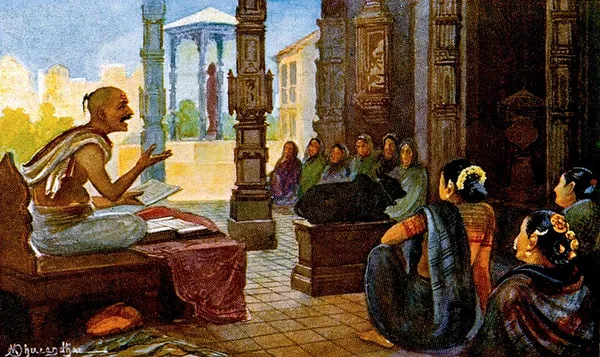
Hindus (Hindustani: [ˈɦɪndu] ; ) are people who religiously adhere to Hinduism. Historically, Hindu has been used as a geographical, cultural, and later religious identifier for people living in the Indian subcontinent. It is assumed that the term "Hindu" traces back to Avestan scripture Vendidad which refers to the land of seven rivers as Hapta Hendu, which itself is cognate with the Sanskrit term Sapta Sindhuḥ. (The term Sapta Sindhuḥ is mentioned in Rig Veda and refers to a Northwestern Indian region of seven rivers and to India as a whole.) The Greek cognates of the same terms are "Indus" (for the river) and "India" (for the land of the river). Likewise, the Hebrew cognate hōd-dū refers to India mentioned in the Hebrew Bible (Book of Esther, Esther 1:1). The term "Hindu" also implied a geographic, ethnic, or cultural identifier for people living in the Indian subcontinent around or beyond the Sindhu (Indus) River. By the 16th century CE, the term began to refer to residents of the subcontinent who were not Turkic or Muslims. The historical development of Hindu self-identity within the local Indian population, in a religious or cultural sense, is unclear. Competing theories state that Hindu identity developed in the British colonial era, or that it may have developed post-8th century CE after the Muslim invasions and medieval Hindu–Muslim wars. A sense of Hindu identity and the term Hindu appears in some texts dated between the 13th and 18th centuries in Sanskrit and Bengali. The 14th- and 18th-century Indian poets such as Vidyapati, Kabir, Tulsidas and Eknath used the phrase Hindu dharma (Hinduism) and contrasted it with Turaka dharma (Islam). The Christian friar Sebastiao Manrique used the term 'Hindu' in a religious context in 1649. In the 18th century, European merchants and colonists began to refer to the followers of Indian religions collectively as Hindus, in contrast to Mohamedans for groups such as Turks, Mughals and Arabs, who were adherents of Islam. By the mid-19th century, colonial orientalist texts further distinguished Hindus from Buddhists, Sikhs, and Jains, but the colonial laws continued to consider all of them to be within the scope of the term Hindu until about the mid-20th century.
Also on this shelf
486th Air Expeditionary Wing.
Corps of Discovery.
See also
Uncatalogued shelfText from Wikipedia; plate via Wikimedia Commons. Text CC BY-SA 4.0; plate freely licensed (see Commons). Source record. Images and catalogue data are reproduced from open-access collections.