Maps and Exploration
Flensburg
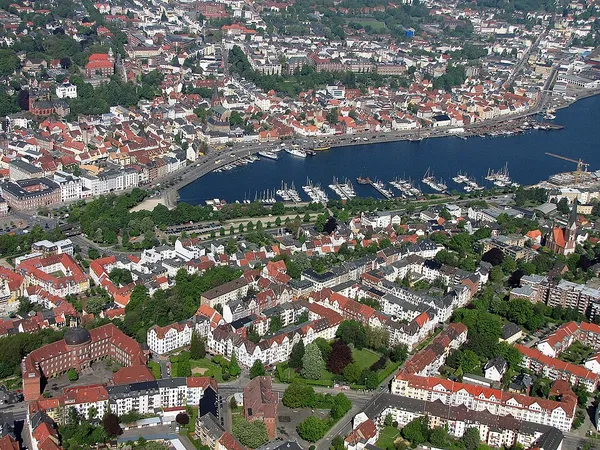
Flensburg (German: [ˈflɛnsbʊɐ̯k] ; Danish and Low Saxon: Flensborg; South Jutlandic: Flensborre; North Frisian: Flansborj, Flensborag) is a town in the German state of Schleswig-Holstein. After Kiel and Lübeck, it is the third-largest urban area in Schleswig-Holstein. Flensburg's city centre lies about 7 km (4 mi) from the Danish border. Flensburg was founded around the 12th century and developed rapidly during the Middle Ages as a major port for trade between the Kingdom of Denmark and the Hanseatic League. In the 16th century, it became part of the Danish Kingdom and remained under Danish rule until the early 19th century. Following the Danish-Prussian War of 1864, Flensburg became part of the Kingdom of Prussia. During the 20th century, the town transformed into a centre for both commerce and industry. It served as the seat of the Flensburg Government, the final administrative (and abortive) form of Nazi Germany, from 2 May 1945 until its dissolution in early June 1945. Today, Flensburg is known for its maritime heritage, its role as a border town with Denmark, and its well-preserved historic architecture. It is the cultural and organisational centre of the Danish minority of Southern Schleswig.
Also on this shelf
2024 United States presidential election in Tennessee.
James Fitzjames.
See also
Uncatalogued shelfText from Wikipedia; plate via Wikimedia Commons. Text CC BY-SA 4.0; plate freely licensed (see Commons). Source record. Images and catalogue data are reproduced from open-access collections.