Maps and Exploration
Amundsen–Scott South Pole Station
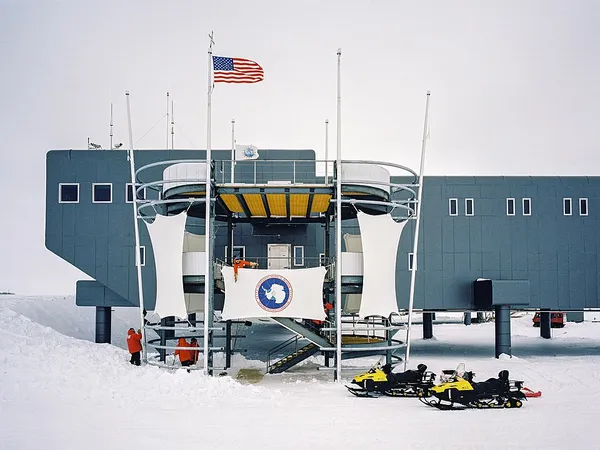
The Amundsen–Scott South Pole Station is a United States scientific research station at the South Pole of the Earth. It is the southernmost point under the jurisdiction (not sovereignty) of the United States. The station is located on the high plateau of Antarctica at 9,301 feet (2,835 m) above sea level. It is administered by the Office of Polar Programs of the National Science Foundation, specifically the United States Antarctic Program (USAP). It is named in honor of Norwegian Roald Amundsen and Briton Robert F. Scott, leaders of the competing first and second expeditions to reach the pole, in the summer of 1911–1912. The original Amundsen–Scott Station was built by Navy Seabees for the federal government of the United States during November 1956, as part of its commitment to the scientific goals of the International Geophysical Year, an effort lasting from January 1957 to June 1958 to study, among other things, the geophysics of the polar regions of Earth. Before November 1956, there was no permanent artificial structure at the pole, and practically no human presence in the interior of Antarctica. The few scientific stations in Antarctica were near its coast. The station has been continuously occupied since it was built and has been rebuilt, expanded, and upgraded several times. The station is the only inhabited place on the surface of the Earth from which the Sun is continuously visible for six months; it is then continuously dark for the next six months, with approximately two days of averaged dark and light, twilight, namely the equinoxes. These are, in observational terms, called one extremely long "day" and one equally long "night". During the six-month "day", the angle of elevation of the Sun above the horizon varies incrementally. The Sun reaches a rising position throughout the September equinox, and then it is apparent highest at the December solstice which is summer solstice for the south, setting on the March equinox. During the six-month polar night, air temperatures can drop below −73 °C (−99 °F) and blizzards are more frequent.
Also on this shelf
Lindemann Performing Arts Center.
Explorer's Grand Slam.
See also
Uncatalogued shelfText from Wikipedia; plate via Wikimedia Commons. Text CC BY-SA 4.0; plate freely licensed (see Commons). Source record. Images and catalogue data are reproduced from open-access collections.