Maps and Exploration
Edmond Halley
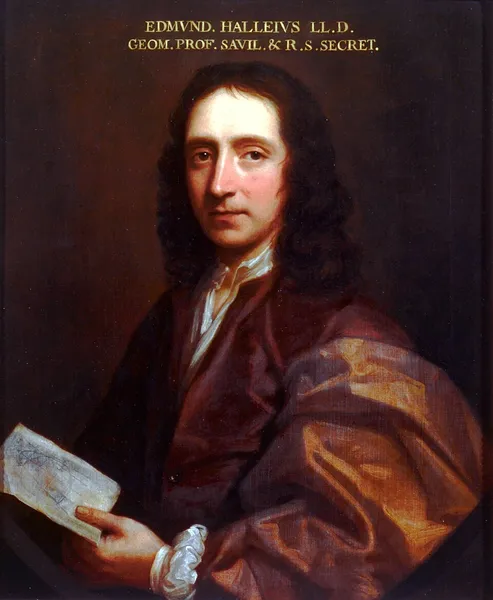
Edmond (or Edmund) Halley (; 8 November [O.S. 29 October] 1656 – 25 January 1742 [O.S. 14 January 1741]) was an English astronomer, mathematician and physicist. He was the second Astronomer Royal in Britain, succeeding John Flamsteed in 1720. From an observatory he constructed on Saint Helena in 1676–77, Halley catalogued the southern celestial hemisphere and recorded a transit of Mercury across the Sun. He realised that a similar transit of Venus could be used to determine the distances between Earth, Venus, and the Sun. Upon his return to England, he was made a fellow of the Royal Society, and with the help of King Charles II, was granted a master's degree from Oxford. Halley encouraged and helped fund the publication of Isaac Newton's influential Philosophiæ Naturalis Principia Mathematica (1687). From observations Halley made in September 1682, he used Newton's law of universal gravitation to compute the periodicity of Halley's Comet in his 1705 Synopsis of the Astronomy of Comets. It was named after him upon its predicted return in 1758, which he did not live to see. Beginning in 1698, Halley made sailing expeditions and made observations on the conditions of terrestrial magnetism. In 1718, he discovered the proper motion of the "fixed stars".
Also on this shelf
Fabian Gottlieb von Bellingshausen.
Austin, Texas.
See also
Uncatalogued shelfText from Wikipedia; plate via Wikimedia Commons. Text CC BY-SA 4.0; plate freely licensed (see Commons). Source record. Images and catalogue data are reproduced from open-access collections.