Maps and Exploration
Deepwater Horizon oil spill
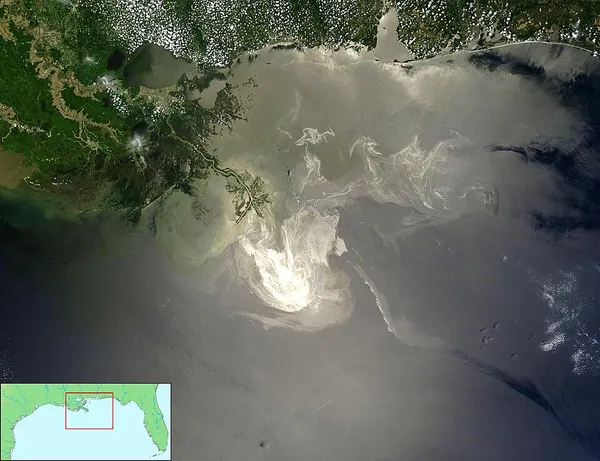
Beginning on 20 April 2010, an explosion on the Deepwater Horizon oil platform caused an oil spill and an environmental disaster off the coast of the United States in the Gulf of Mexico, on the BP-operated Macondo Prospect. It is considered the largest marine oil spill in the history of the petroleum industry and estimated to be 8 to 31 percent larger in volume than the previous largest, the Ixtoc I oil spill, also in the Gulf of Mexico. The United States federal government estimated the total discharge at 4.9 million barrels (210,000,000 US gal; 780,000 m3). After several failed efforts to contain the flow, the well was declared sealed on 19 September 2010. Reports in early 2012 indicated that the well site was still leaking. The Deepwater Horizon oil spill is regarded as one of the largest environmental disasters in world history. A massive response ensued to protect beaches, wetlands and estuaries from the spreading oil utilizing skimmer ships, floating booms, controlled burns and 1,840,000 US gal (7,000 m3) of oil dispersant. Due to the months-long spill, along with adverse effects from the response and cleanup activities, extensive damage to marine and wildlife habitats and fishing and tourism industries was reported. In Louisiana, oil cleanup crews worked four days a week on 55 mi (89 km) of Louisiana shoreline throughout 2013. 4,900,000 lb (2,200 t) of oily material was removed from the beaches in 2013, over double the amount collected in 2012. Oil continued to be found as far from the Macondo site as the waters off the Florida panhandle and Tampa Bay, where scientists said the oil and dispersant mixture is embedded in the sand. In April 2013, it was reported that dolphins and other marine life continued to die in record numbers with infant dolphins dying at six times the normal rate. One study released in 2014 reported that tuna and amberjack exposed to oil from the spill developed deformities of the heart and other organs which would be expected to be fatal or at least life-shortening; another study found that cardiotoxicity might have been widespread in animal life exposed to the spill. Numerous investigations examined the causes of the explosion and record-setting oil spill.
Also on this shelf
Farthest North.
Georg von Langsdorff.
See also
Uncatalogued shelfText from Wikipedia; plate via Wikimedia Commons. Text CC BY-SA 4.0; plate freely licensed (see Commons). Source record. Images and catalogue data are reproduced from open-access collections.