Maps and Exploration
Giszowiec
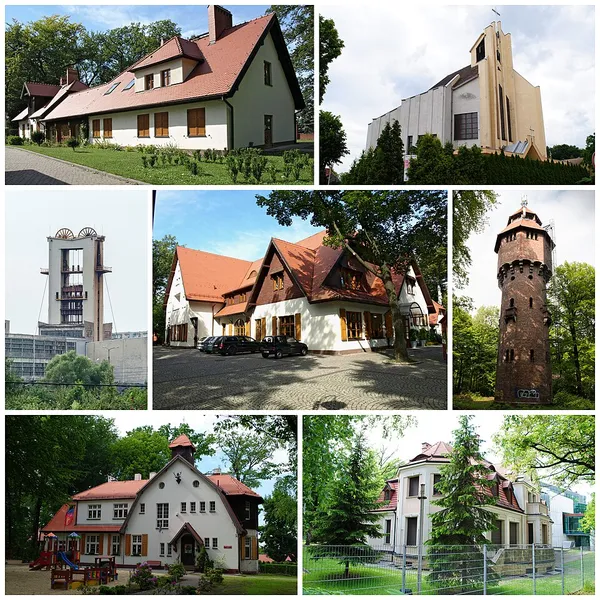
Giszowiec (German: Gieschewald) is a historic company town, a part and an eastern district of the city of Katowice (Silesian Voivodeship, Poland), created as a coal miners' settlement in 1907. Initially consisting of about 3,300 miners and their families, the district's population have grown over the years to over 18,000. Although Giszowiec's architectural originality suffered major damages in the 1970s and 1980s due to large scale urbanization, its early unique character can be still felt in the surviving miners' housings, the marketplace, numerous individual buildings and structures, as well as the relatively well preserved general design of a "Garden city". Giszowiec consists of large-panel-system buildings and historic houses, mostly single- and two-family, which once formed a compact mining housing estate that remains unique in Europe to this day and is part of the Silesian Industrial Monuments Route. It was built for miners working at the Giesche Coal Mine (later the Wieczorek Coal Mine) by the Georg von Giesches Erben company, commissioned by its director Anton Uthemann between 1907 and 1910. The housing estate was designed by Emil and Georg Zillmann. Two-thirds of the mining settlement was demolished in the 1970s as a result of the development of high-rise large-panel-system buildings for employees of the Staszic Coal Mine, established in 1964. Giszowiec is mainly a residential and industrial area. It is surrounded by two major transportation routes: national road 86 and the A4 motorway, and national road 81 begins there. The district covers an area of 12.03 km² (7.30% of the city's total area) and had a population of 15,719 in 2019.
Also on this shelf
Auldbrass Plantation.
Granada Cathedral.
See also
Uncatalogued shelfText from Wikipedia; plate via Wikimedia Commons. Text CC BY-SA 4.0; plate freely licensed (see Commons). Source record. Images and catalogue data are reproduced from open-access collections.