Maps and Exploration
Delhi Sultanate
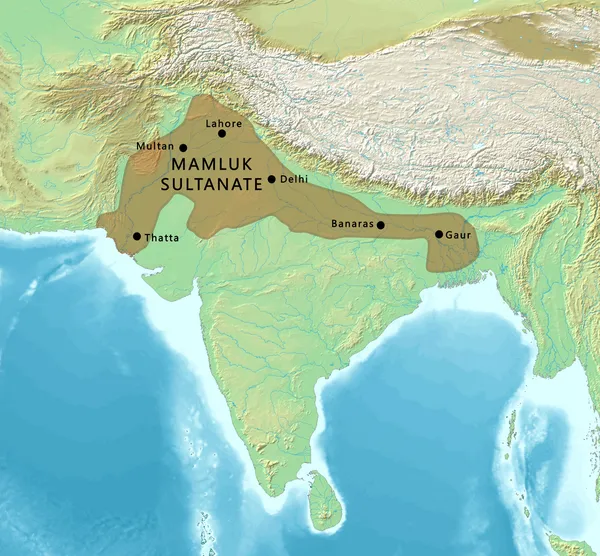
The Delhi Sultanate or the Sultanate of Delhi was a late medieval empire primarily based in Delhi that stretched over large parts of the Indian subcontinent for more than three centuries. The sultanate was established in 1206 in the former Ghurid territories in India. Its history is generally divided into five periods: Mamluk (1206–1290), Khalji (1290–1320), Tughlaq (1320–1414), Sayyid (1414–1451), and Lodi (1451–1526). It covered large swaths of territory in modern-day India, Pakistan, Bangladesh, as well as some parts of southern Nepal. The foundation of the sultanate was laid by the Ghurid conqueror Muhammad Ghori, who routed the Rajput Confederacy, led by Ajmer ruler Prithviraj Chauhan, in 1192 near Tarain, in a reversal of an earlier battle. As a successor to the Ghurid dynasty, the Delhi Sultanate was originally one of several principalities ruled by the Turkic slave-generals of Muhammad Ghori, including Taj al-Din Yildiz, Qutb ud-Din Aibak, Bahauddin Tughril and Nasir ad-Din Qabacha, who had inherited and divided the Ghurid territories amongst themselves. Khalji and Tughlaq rule ushered a new wave of rapid and continual Muslim conquests deep into South India. The sultanate reached its geographical zenith under the Tughlaq dynasty, occupying most of the Indian subcontinent during the reign of Muhammad bin Tughluq. A major political transformation occurred across northern India, triggered by the Central Asian king Timur's devastating raid on Delhi in 1398, coinciding with the re-emergence of rival Hindu powers such as Vijayanagara Empire and Kingdom of Mewar, and new Muslim sultanates such as the Bengal and Bahmani Sultanates asserting independence. In 1526, Timurid ruler Babur invaded northern India and conquered the sultanate, leading to its succession by the Mughal Empire. The establishment of the Sultanate drew the Indian subcontinent more closely into international and multicultural Islamic social and economic networks, as seen concretely in the development of the Hindustani language and Indo-Islamic architecture. It was also one of the few powers to repel attacks by the Mongols (from the Chagatai Khanate) and saw the enthronement of one of the few female rulers in Islamic history, Razia Sultana (r. 1236 – 1240).
Also on this shelf
Chinese astronomy.
Cheshire.
See also
Uncatalogued shelfText from Wikipedia; plate via Wikimedia Commons. Text CC BY-SA 4.0; plate freely licensed (see Commons). Source record. Images and catalogue data are reproduced from open-access collections.