Maps and Exploration
Climate of Greece
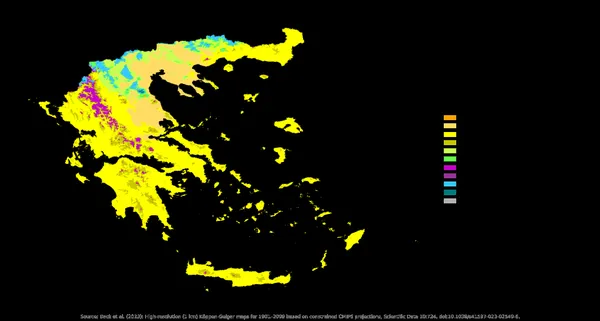
The climate in Greece is predominantly Mediterranean. However, due to the country's complex geography, Greece has a wide range of micro-climates and local variations. The Greek mainland is extremely mountainous, making Greece one of the most mountainous countries in Europe. According to the Köppen climate classification Greece has 11 climates, the most in Europe for its size. To the west of the Pindus mountain range, the climate is generally wetter and has some maritime features. The east of the Pindus mountain range is generally drier and windier in summer. The highest peak is Mount Olympus, 2,918 metres (9,573 ft). The northern areas of Greece have a transitional climate between the continental, the Mediterranean and the humid subtropical climate while there are marginal mountainous areas with an alpine climate. Semi-arid climates are the second most common in Greece. Average annual temperatures in Greece range from around +4 °C (39 °F) in Kaimaktsalan up to +22 °C (72 °F) in Lindos and Tris Ekklisies. The lowest average annual precipitation is recorded in Xerokampos with 219 mm while the highest is found in Theodoriana with 2529 mm. The highest temperature ever recorded was 48.0 °C (118.4 °F) in Tatoi and Elefsina while the lowest was −27.8 °C (−18.0 °F) in Ptolemaida (a -35.3 °C was recorded in a sinkhole in Kechroti). Hardiness zones in Greece vary from 11a to 6a (in sinkholes).
Also on this shelf
Alexander von Middendorff.
Canadians.
See also
Uncatalogued shelfText from Wikipedia; plate via Wikimedia Commons. Text CC BY-SA 4.0; plate freely licensed (see Commons). Source record. Images and catalogue data are reproduced from open-access collections.