Maps and Exploration
Demographics of Morocco
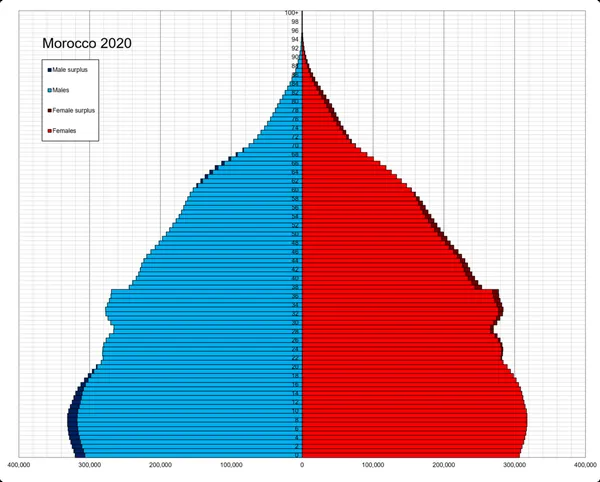
Demographic features of the population of Morocco include population density, ethnicity, religious affiliations and other aspects of the population. All figures are from the Haut-Commissariat au Plan of Morocco or the United Nations Demographic Yearbooks, unless otherwise indicated. The population of Morocco in 2024 was 36,828,330. Moroccans are primarily of Arab, Berber, and Morisco origins. Socially, there are two contrasting groups of Moroccans: those living in the cities and those in rural areas. Among Morocco's rural communities, several socio-economic classes have formed. The majority of the Moroccan population lives in northwestern Morocco, along the fertile coastal regions near the Mediterranean Sea. About 99 percent of Moroccans are considered to be Sunni Muslims (either religiously or culturally). The significant and millennia-old Jewish minority has largely decreased since the creation of the State of Israel in 1948. Today there are 2,500 Moroccan Jews inside the country. Thousands of Moroccan Jews living in Europe, Israel-Palestine, and the Americas regularly visit the Morocco. There is a small minority of Moroccan Christians. In 2014, most of the 86,206 foreign residents are French, Spaniards, Algerians, and sub-Saharan African migrants.
Also on this shelf
Baldwin-Ziegler Polar Expedition.
Boston.
See also
Uncatalogued shelfText from Wikipedia; plate via Wikimedia Commons. Text CC BY-SA 4.0; plate freely licensed (see Commons). Source record. Images and catalogue data are reproduced from open-access collections.