Maps and Exploration
Andrew Jackson and the slave trade
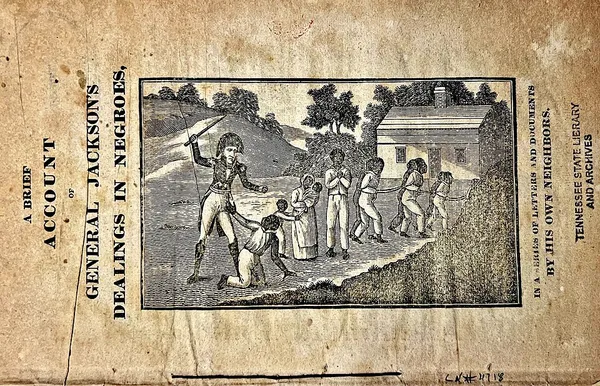
Andrew Jackson was an American slave trader and freebooter who became the seventh president of the United States. Jackson (lifespan, 1767–1845; U.S. presidency, 1829–1837) bought and sold slaves from 1788 until 1844, both for use as a plantation labor force and for short-term financial gain through slave arbitrage. Jackson was most active in the interregional slave trade, which he termed "the mercantile transactions", from the 1790s through the 1810s. Available evidence shows that speculator Jackson trafficked people between his hometown of Nashville, Tennessee, and the slave markets of the lower Mississippi River valley. Unlike the Founding Father presidents, Jackson inherited no slaves or lands from his parents. Jackson bought and sold outright, but slaves also served as barter for trade goods, currency for real estate transactions, and as the stakes in bets on horse races. "Cash or negroes" were the preferred payment methods of the frontier U.S. south. While Jackson had a number of business interests in Tennessee, many of Jackson's slave sales took place in the Natchez District in what is now the state of Mississippi, the Feliciana District in what is now the state of Louisiana, and in New Orleans. Jackson ran a trading stand and saloon in the vicinity of Bruinsburg, Mississippi (not far from Port Gibson), and/or at Old Greenville, two now-extinct settlements at the southern end of an Indigenous trade route known to history as the Natchez Trace. Jackson's customers included his wife's sister's extended family and their neighbors, Anglo-American settlers who owned tobacco farms and cotton plantations worked by slave labor. Jackson seems to have traded in partnership with his Donelson brothers-in-law and nephews. After 1800, Jackson often tasked his nephew-by-marriage John Hutchings with escorting their shipments to the lower country. In 1812, while arguing over a coffle that he himself had shopped around Natchez, Andrew Jackson admitted in writing that he was an experienced slave trader, stating that his cost for "Negroes sent to markett [sic]...never averaged more from here than fifteen dollars a head." Jackson's slave trading was a major issue during the 1828 United States presidential election. Some of Jackson's accusers during the 1828 campaign had known him for decades and were themselves affiliated with the trade.
Also on this shelf
Archiepiscopal Towers Interpretation Centre.
French Pavilion of Versailles.
See also
Uncatalogued shelfText from Wikipedia; plate via Wikimedia Commons. Text CC BY-SA 4.0; plate freely licensed (see Commons). Source record. Images and catalogue data are reproduced from open-access collections.