Maps and Exploration
Allal al-Fassi
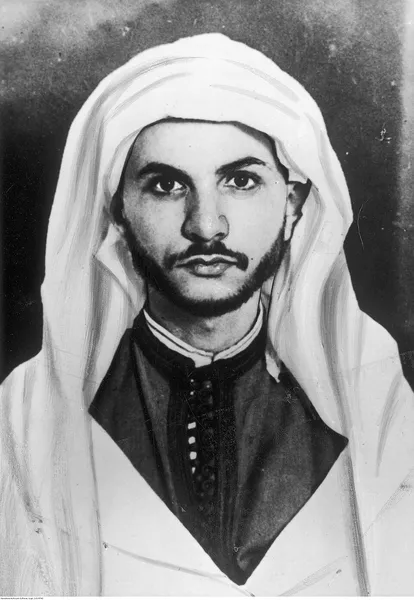
Muhammad Allal al-Fassi (Arabic: محمد علال الفاسي, romanized: Muḥammad ʿAllāl al-Fāsī; 10 January 1910 – 13 May 1974) was a Moroccan politician, poet and Islamic scholar who was one of the early leaders of the Moroccan nationalist movement. Upon independence in 1956, he became leader of the Istiqlal Party representing it until his death in 1974. He served briefly as Minister of Islamic Affairs from 1961 to 1963. Born into the prominent scholarly Fassi Fihri family, he became involved in the Moroccan nationalist movement at a young age during his years as a student at al-Qarawiyyin. In response to the Berber Dahir, he helped to arouse protest and began to coordinate with other nationalists leading to the formation of nationalist parties like the Moroccan Action Committee. After riots broke out in 1937, al-Fassi was exiled to Gabon for 10 years. During his exile, the Istiqlal Party was formed and he was given the honorary role of zaʿīm. Whilst in self-exile in Cairo, he collaborated with other nationalist leaders from the Maghreb. After independence, he was appointed head of the codification commission for the Mudawana. After his resignation as Minister of Islamic Affairs, al-Fassi became a prominent opposition leader against Hassan II's government. He died of a heart attack on a trip to Romanian leader Nicolae Ceaușescu. He was a "neo-Salafist" who advocated for the synthesis of nationalism and reformist Salafism. As an advocate for an Arab-Islamic identity for Morocco, he wanted a Morocco that imposed Arabisation and ruled by Sharia. He developed the idea of Greater Morocco. He was also a prolific writer who wrote over forty books and articles. He has been described as the "father of Moroccan nationalism".
Also on this shelf
Hubert H. Humphrey Building.
History of navigation.
See also
Uncatalogued shelfText from Wikipedia; plate via Wikimedia Commons. Text CC BY-SA 4.0; plate freely licensed (see Commons). Source record. Images and catalogue data are reproduced from open-access collections.