Maps and Exploration
Ford Expedition
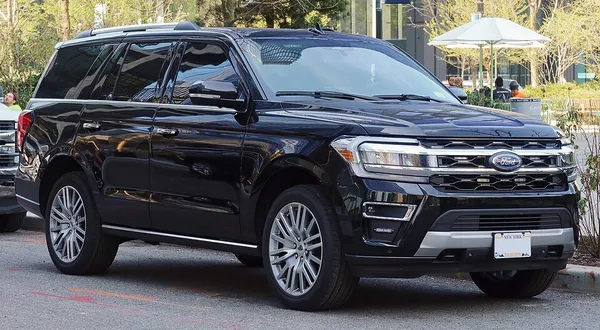
The Ford Expedition is a full-size SUV produced by Ford Motor Company since the 1997 model year. Introduced as the replacement for the 1978–1996 Ford Bronco, the Expedition again maintained commonality with the F-150, shifting its form factor to a truck-based five-door station wagon. Initially competing between the Chevrolet Tahoe and Chevrolet Suburban (and their GMC Yukon counterparts), the Expedition also serves a competitor against the Toyota Sequoia, Nissan Armada, and the Jeep (Grand) Wagoneer. From 2000 to 2006, the Expedition was slotted below the Ford Excursion in size (based on the Ford F-250 Super Duty). Currently in its fifth generation (introduced for 2025), the Expedition is produced in two wheelbases, with both versions offering seating for up to eight passengers. For its first two generations, the Ford Expedition shared the Ford P platform with the Ford F-150, shifting to the Ford T platform, which it uses today. Since its second generation (introduced for 2003), the Expedition has differed from the F-150 in its use of independent suspension for all four wheels, becoming the first full-size SUV to do so. Since 1998, the Expedition has shared its platform with the Lincoln Navigator, the first full-size luxury SUV. Ford currently assembles the Expedition at its Kentucky Truck Assembly facility (Louisville, Kentucky) alongside the Lincoln Navigator and Super Duty trucks (F-250 to F-600). Prior to 2009, the model line was assembled by the Michigan Assembly Plant (Wayne, Michigan).
Also on this shelf
Amsterdam Zuid station.
Cardiff Crown Court.
See also
- ▸Climate change in the United States
- ▸Koto (instrument)
- ▸Fraunhofer Institute for Telecommunications
Text from Wikipedia; plate via Wikimedia Commons. Text CC BY-SA 4.0; plate freely licensed (see Commons). Source record. Images and catalogue data are reproduced from open-access collections.