Maps and Exploration
Climatic regions of Argentina
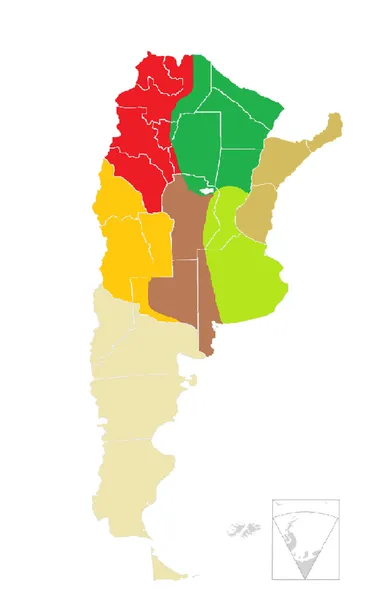
Due to its vast size and range of altitudes, Argentina possesses a wide variety of climatic regions, ranging from the hot subtropical region in the north to the cold subantarctic in the far south. The Pampas region lies between those and featured a mild and humid climate. Many regions have different, often contrasting, microclimates. In general, Argentina has four main climate types: warm, moderate, arid, and cold in which the relief features, and the latitudinal extent of the country, determine the different varieties within the main climate types. Northern parts of the country are characterized by hot, humid summers with mild, drier winters, and highly seasonal precipitation. Mesopotamia, located in northeast Argentina, has a subtropical climate with no dry season and is characterized by high temperatures and abundant rainfall because of exposure to moist easterly winds from the Atlantic Ocean throughout the year. The Chaco region in the center-north, despite being relatively homogeneous in terms of precipitation and temperature, is the warmest region in Argentina, and one of the few natural areas in the world located between tropical and temperate latitudes that is not a desert. Precipitation decreases from east to west in the Chaco region because eastern areas are more influenced by moist air from the Atlantic Ocean than the west, resulting in the vegetation transitioning from forests and marshes to shrubs. Northwest Argentina is predominantly dry, hot, and subtropical although its rugged topography results in a diverse climate. Central Argentina, which includes the Pampas to the east, and the Cuyo region to the west, has a temperate climate with hot summers and cool, drier winters. In the Cuyo region, the Andes obstruct the path of rain-bearing clouds from the Pacific Ocean; moreover, its latitude coincides with the subtropical high. Both factors render the region dry. With a wide range of altitudes, the Cuyo region is climatically diverse, with icy conditions persisting at altitudes higher than 4,000 m (13,000 ft). The Pampas is mostly flat and receives more precipitation, averaging 500 mm (20 in) in the western parts to 1,200 mm (47 in) in the eastern parts. The weather in the Pampas is variable due to the contrasting air masses and frontal storms that impact the region.
Also on this shelf
Crescent Theater.
Denis G. Lillie.
See also
Uncatalogued shelfText from Wikipedia; plate via Wikimedia Commons. Text CC BY-SA 4.0; plate freely licensed (see Commons). Source record. Images and catalogue data are reproduced from open-access collections.