Maps and Exploration
Economy of Denmark
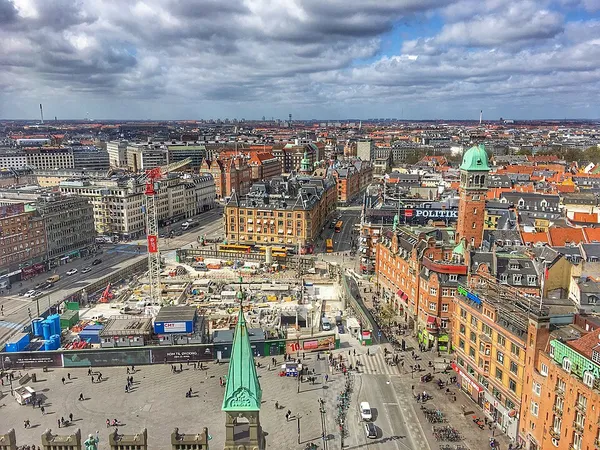
Denmark has a modern high-income and highly developed social market economy, dominated by the service sector with 80% of all jobs; about 11% of employees work in manufacturing and 2% in agriculture. The nominal gross national income per capita was the ninth-highest in the world at $68,827 in 2023. Denmark follows the Nordic model, characterized by an internationally high tax level, and a correspondingly high level of government-provided services (e.g. health care, child care and education services). There are also income transfers to various groups, such as retirees, disabled people, the unemployed, and students. Correcting for purchasing power, per capita income was Int$57,781 or 10th-highest globally. The income distribution is relatively equal but inequality has somewhat increased during the last decades. In 2017, Denmark had the seventh-lowest Gini coefficient (a measure of economic inequality) of the then 28 European Union countries. With 5,932,654 inhabitants as of 1 January 2023, Denmark has the 38th largest national economy in the world measured by nominal gross domestic product (GDP), and the 52nd largest in the world measured by purchasing power parity (PPP). Among OECD nations, Denmark has a highly efficient and strong social security system; social expenditure stood at roughly 26.2% of GDP. Denmark has a very long tradition of adhering to a fixed exchange-rate system and still does so today. It is unique among OECD countries to do so while maintaining an independent currency: the Danish Krone, which is pegged to the euro. Though eligible to join the EU's Economic and Monetary Union (EMU), Danish voters in a referendum in 2000 rejected exchanging the krone for the euro. Whereas Denmark's neighbours like Norway, Sweden, Poland and the United Kingdom generally follow inflation targeting in their monetary policy, the priority of Denmark's central bank is to maintain exchange rate stability. Consequently, the central bank has no role in a domestic stabilization policy. In an international context, a relatively large proportion of the population is part of the labour force, in particular because the female participation rate is very high. 78.8% of all 15-to-64-year-olds were active in the labour market in 2017, the sixth-highest number among all OECD countries.
Also on this shelf
Guaraguao.
Former Caswell Public Library.
See also
Uncatalogued shelfText from Wikipedia; plate via Wikimedia Commons. Text CC BY-SA 4.0; plate freely licensed (see Commons). Source record. Images and catalogue data are reproduced from open-access collections.