Maps and Exploration
Climate change in the Arctic
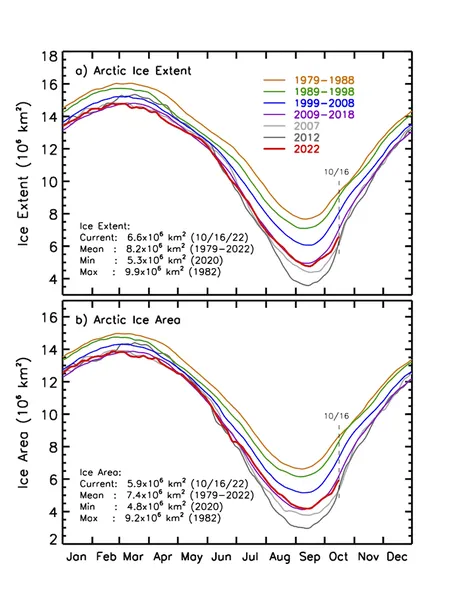
Due to climate change in the Arctic, this polar region is expected to become "profoundly different" by 2050. The speed of change is "among the highest in the world", with warming occurring at 3-4 times faster than the global average. This warming has already resulted in the profound Arctic sea ice decline, the accelerating melting of the Greenland ice sheet and the thawing of the permafrost landscape. These ongoing transformations are expected to be irreversible for centuries or even millennia. Natural life in the Arctic is affected greatly. As the tundra warms, its soil becomes more hospitable to earthworms and larger plants, and the boreal forests spread to the north - yet this also makes the landscape more prone to wildfires, which take longer to recover from than in the other regions. Beavers also take advantage of this warming to colonize the Arctic rivers, and their dams contributing to methane emissions due to the increase in stagnant waters. The Arctic Ocean has experienced a large increase in the marine primary production as warmer waters and less shade from sea ice benefit phytoplankton. At the same time, it is already less alkaline than the rest of the global ocean, so ocean acidification caused by the increasing CO2 concentrations is more severe, threatening some forms of zooplankton such as pteropods. The Arctic Ocean is expected to see its first ice-free events in the near future - most likely before 2050, and potentially in the late 2020s or early 2030s. This would have no precedent in the last 700,000 years. Some sea ice regrows every Arctic winter, but such events are expected to occur more and more frequently as the warming increases. This has great implications for the fauna species which are dependent on sea ice, such as polar bears. For humans, trade routes across the ocean will become more convenient. Yet, multiple countries have infrastructure in the Arctic which is worth billions of dollars, and it is threatened with collapse as the underlying permafrost thaws. The Arctic's indigenous people have a long relationship with its icy conditions, and face the loss of their cultural heritage. Further, there are numerous implications which go beyond the Arctic region. Sea ice loss not only enhances warming in the Arctic but also adds to global temperature increase through the ice-albedo feedback.
Also on this shelf
Island of California.
Gould House (Norfolk, Connecticut).
See also
Uncatalogued shelfText from Wikipedia; plate via Wikimedia Commons. Text CC BY-SA 4.0; plate freely licensed (see Commons). Source record. Images and catalogue data are reproduced from open-access collections.